| Blog Summary |
|---|
| Diabetes Mellitus is one of the fastest-growing chronic conditions, and much of its long-term care rests with doctors. Poor or delayed control raises the risk of complications, while early and well-informed management can improve prognosis. This guide is for doctors who want structured training in diabetes care. It covers what the Certificate in Diabetes Mellitus includes, who can enrol, the online format, fees, how it compares with a fellowship, and how it can help in clinical practice. |
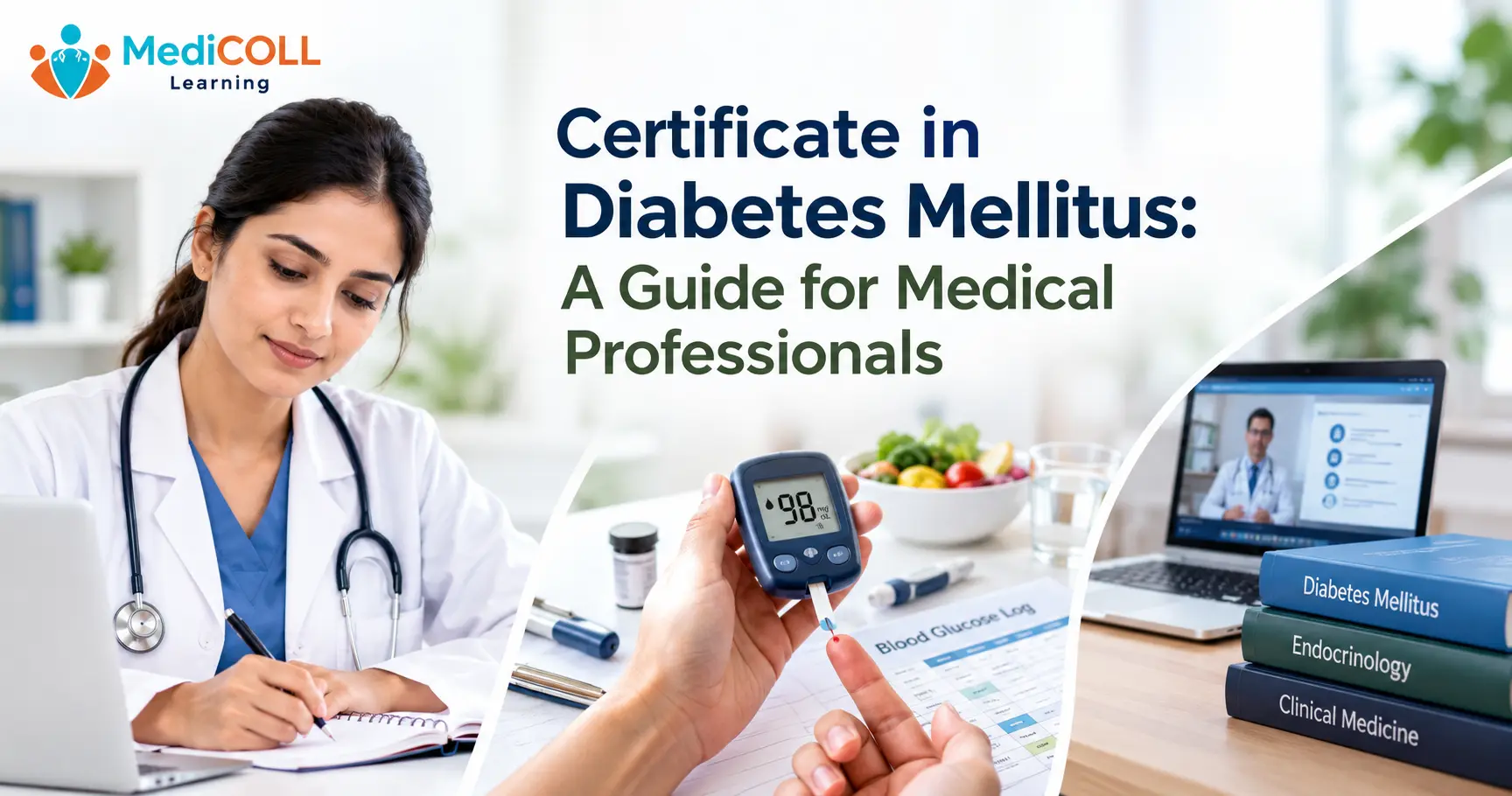
A Certificate in Diabetes Mellitus is a short-term course that well equips the doctors to diagnose, treat and follow up patients with diabetes mellitus. It covers lifestyle care, oral drugs, injectables and insulin.
Most doctors see patients with diabetes in their daily practice, whether in clinics or hospitals. Diabetes care keeps changing, with newer drug classes and updated treatment approaches, so ongoing learning helps doctors manage these patients with more confidence.
The Certificate in Diabetes Mellitus is a targeted short duration program structured to focus on the diagnosis and management of diabetes. It helps doctors bring more clarity and consistency to the diabetes care they already provide.
The course starts with the main types of diabetes:
Diabetes Mellitus Certificate Courses help doctors manage diabetes with more confidence, with training on newer drugs, insulin adjustment and risk assessment. The certificate offers additional training in diabetes care.
The main difference between a certificate and a post graduate specialist degree lies in depth and duration. Specialist postgraduate degrees like an MD in Medicine or a DM in Endocrinology involve years of supervised residency while a certificate sharpens practice but does not change a doctor's specialty.

Diabetes is a long-term condition, and for most patients, the journey of treatment begins outside specialist clinics. Primary care doctors handle diagnosis, treatment changes and follow-up for years at a stretch.
Therefore, an additional diabetes management course can help doctors manage patients better, specifically in the following areas:
Bringing these areas together helps the doctor see the patient's care as one continuous plan, rather than a series of separate visits.
Eligibility for a diabetes course for doctors depends on the program requirements and the institute offering it. Generally, eligible candidates include MBBS graduates, postgraduates such as MD, DNB and FNB holders, and AYUSH doctors. Final-year MBBS students and International Medical Graduates can also apply.
MBBS doctors can pursue a diabetes certificate course, and they form a large part of the group that takes this training. Many work in general practice, clinics or hospital casualty, where they see patients with diabetes regularly. For them, the certificate offers structured training in the subject.
The purpose of taking a Certificate in Diabetes Mellitus after MBBS is focused, additional education. It builds on the pharmacology, physiology and medicine already learned in graduation and adds diabetes-specific clinical thinking on top.
The curriculum of a certificate course depends on the institute and the duration of the course. MediCOLL is an online platform that provides accredited medical courses in various sub-specialites such as diabetes mellitus to the doctors and supports continuous professional development.
The curriculum is designed by experienced diabetologists and moves from glucose metabolism to diagnosis, lifestyle care, drug therapy and insulin, across six modules.
Throughout, this diabetes course for doctors keeps clinical use in view in addition to theoretical knowledge. Some of the topics covered in the curriculum are:
The 6 months Certificate in Diabetes Mellitus covers all the key aspects of diabetes care and gives doctors a pace that suits them alongside practice. For most working doctors, the course fits well between professional and personal commitments, as the entire course runs online. The online format also means there is no need to take leave or relocate.
The certificate also gives doctors a chance to explore the field and then decide whether a 12-month fellowship makes sense. Therefore, a 6 month diabetes course works as a practical starting point for further training.
The course is delivered through a digital platform, with lectures, study material and assessments all online. Doctors can learn from home or clinic without an interruption to patient care.
Online diabetes programs usually combine several elements such as online lectures, digital learning resources, case discussions, assessments and flexible timing for working doctors.
Before enrolling in an Online Certificate in Diabetes Mellitus, doctors should check on a few things such as faculty qualifications, curriculum, duration, clinical exposure where applicable, recognition of the certificate and student support to see if any help is available for technical or academic doubts.
Fees for diabetes certificate programs vary between providers. The difference usually comes down to how long the course runs and what it includes.
The factors that determine a course fee depends on:
Current course fee at the time of publication: The 6 months Certificate in Diabetes Mellitus offered by MediCOLL costs ₹70,000, inclusive of all taxes. An EMI option is also available for doctors who prefer not to pay the full amount at once, at no extra interest through financing.
The right certificate depends largely on a doctor's own needs and preferences. Delivery mode, the time a doctor can give, the recognition of the certificate and how it fits long-term career plans all play a part.
A few points to consider:
The certificate and the fellowship serve different purposes. The certificate gives focused knowledge in a short time, while the fellowship adds a longer academic period and supervised clinical training.
Both the Fellowship and the Certificate in Diabetes Mellitus are delivered by MediCOLL and carry affiliations with NHS, eIntegrity, the University of Liverpool and Mangalayatan University.
Key differences at a glance:
| Feature | Certificate in Diabetes Mellitus | Fellowship in Diabetes Mellitus |
|---|---|---|
| Duration | 6 months | 12 months |
| Learning format | Fully online | Hybrid: 10 months online classes, 2 months clinical training |
| Clinical exposure | Not included | Supervised training in a super specialty hospital |
| Depth of learning | Focused core diabetes care | Longer, more detailed study |
| Intended purpose | Stronger diabetes knowledge alongside practice | Deeper training with hands-on exposure |
| Professional development | Upskilling for current practice | Broader preparation for diabetes-focused work |
| Fee (at publication) | ₹70,000 | ₹1,55,000 |
Both programs offer meaningful value, and the choice mostly depends on how far a doctor wants to take their diabetes training. For instance, a general practitioner who sees patients with diabetes every day and wants to manage them with more confidence may find the certificate enough. However, a doctor planning a diabetes-focused practice may prefer the supervised hospital exposure in the Fellowship in Diabetes Mellitus. Some doctors take the certificate first and move to the fellowship later.
The diabetes mellitus course builds practical clinical skills for routine consultations. Most of them apply directly to everyday OPD and ward work.
An online Certificate in Diabetes Mellitus strengthens existing clinical skills and adds expertise that shows up mainly in day-to-day patient care. Doctors after completing the certificate can:
The answer depends on a doctor's qualification, practice and goals, and on what they expect from a diabetes mellitus course. A short checklist can help with the decision:
The certificate is likely a good fit if most answers are yes and clinical exposure is not an immediate need. It also gives doctors a chance to decide later whether they want to build deeper knowledge and skills through further training
An online Certificate in Diabetes Mellitus sharpens existing clinical knowledge and skills, and strengthens decision-making in everyday diabetes care. For many doctors, it becomes a first step towards focused training and further diabetes or endocrinology education. Doctors who want deeper training with supervised hospital exposure can look at a fellowship next. For a doctor who sees diabetes every week and wants to manage it with more certainty, a focused certificate is a sensible place to begin.
A Certificate in Diabetes Mellitus is a 6-month course for doctors. It strengthens clinical skills and provides focused knowledge for effective patient management.
The fee depends on the institute and the duration of the course. The fee offered by MediCOLL is ₹70,000 and an EMI option is also available for doctors who prefer not to pay the full amount upfront.
Yes, doctors can pursue a Certificate in Diabetes Mellitus after MBBS. Many experienced doctors also take such courses to add focused diabetes skills to their practice.
The main difference lies in duration, depth of curriculum and clinical training. The certificate runs for 6 months fully online, while the fellowship runs for 12 months and includes 2 months of supervised clinical training in a super specialty hospital.
No. A diabetes mellitus course certificate adds focused knowledge but does not confer a specialist qualification. Specialisation in this field requires a postgraduate route, such as an MD followed by a DM in Endocrinology.
© Copyrights Medicoll All rights reserved.