| Blog Summary |
|---|
| Diploma in Family Medicine is a structured training program for doctors that develops skills in comprehensive primary care, preventive medicine, chronic disease management, and patient care across different age groups. The course covers eligibility, curriculum, duration, fees, online and blended learning options, and career opportunities. It also compares diploma and certificate programs and highlights key factors such as accreditation, clinical exposure, faculty, total fees, and recognition that doctors should consider before enrolling. |
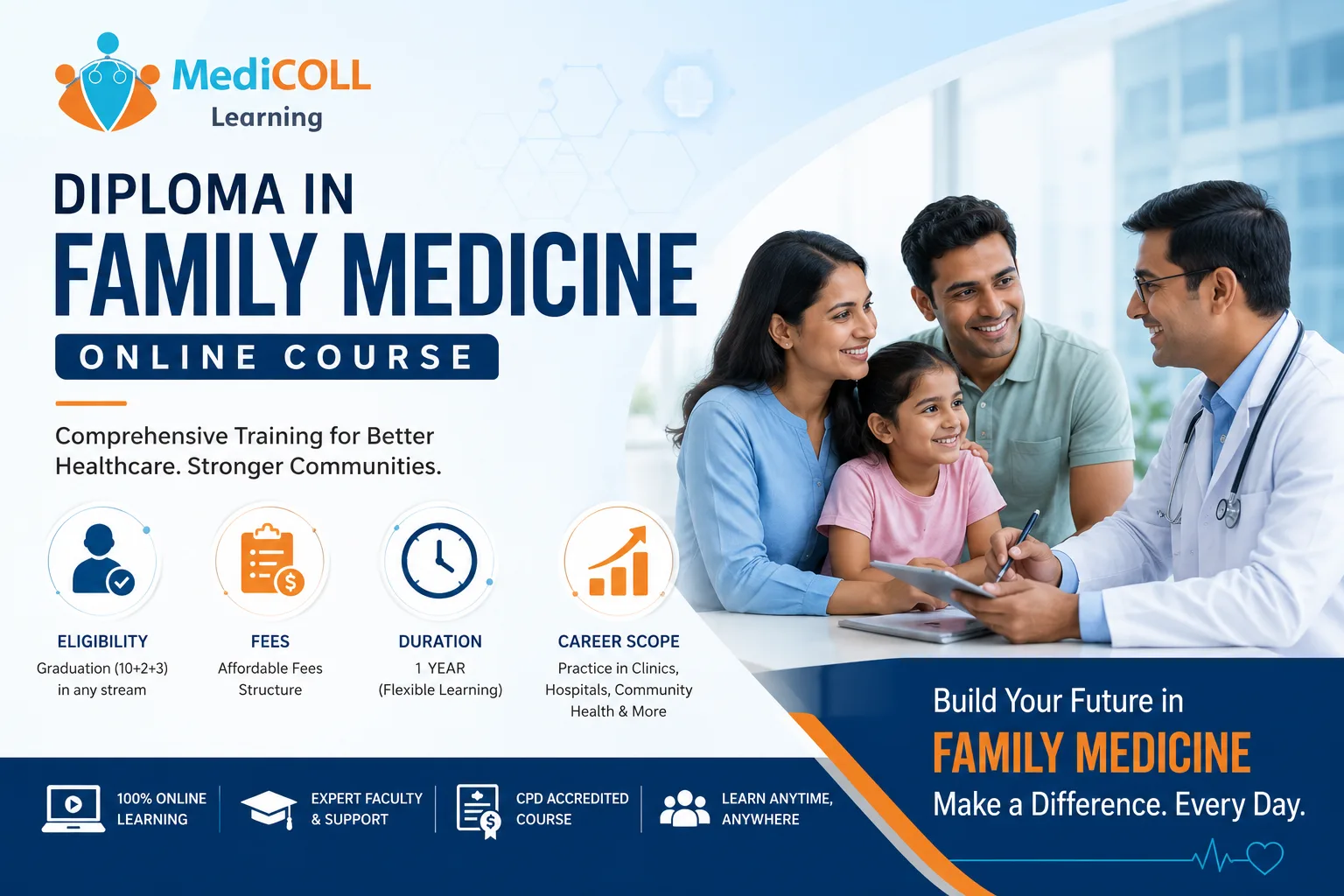
A Diploma in Family Medicine trains doctors to manage patients across all ages, not just one organ system or one disease. It builds on the everyday work of a general physician and adds structure around preventive care, chronic disease management, and continuity of care. For many doctors, this becomes the natural next step after a few years of clinical practice, especially those working in outpatient settings who want to sharpen how they handle a broad caseload.
As primary care demand keeps rising, doctors are looking for structured ways to formalize skills they already use daily. However, before enrolling in any courses such as fellowships or diplomas, it is crucial to understand what such a course typically involves so the medical professional knows if it is a suitable fit for them.
A Family Medicine Diploma Course is a structured training program built around the core competencies of family practice namely preventive health, chronic disease care, and patient-centered management across age groups. One of the examples of this comes from the World Health Organization's (WHO) Regional Office for the Eastern . Mediterranean which developed a Regional Professional Diploma in Family Medicine to give general practitioners the skills needed to function as family physicians.
This program was built around competencies defined by WONCA, the Accreditation Council for Graduate Medical Education, and the College of Family Physicians of Canada, and it was launched with the Arab Board of Health Specializations as a 12-month bridging course.
A diploma is typically shorter and more focused than a full postgraduate degree, and it is designed for doctors who already have a basic medical qualification but want deeper training in comprehensive patient management. It is different from a short continuing medical education (CME) course which usually updates knowledge on a specific topic over a few days or weeks.
Doctors who can benefit from a diploma are general physicians handling a broad outpatient caseload, doctors in smaller areas without easy specialist access, and any medical professional who wants formal recognition.
Curricula of the Family Medicine Diploma Course can vary between institutions, but most programs touch on similar ground. The general outline of the curriculum includes:
Diploma in Family Medicine Eligibility criteria differ across programs, but most have a few basic requirements. A candidate usually needs an MBBS or equivalent medical degree, and active registration with a relevant medical council.
Some programs are open only to practicing doctors, since the training assumes a working clinical background. WHO's regional diploma, for instance, asks applicants for a curriculum vitae, a personal statement, a certified copy of their medical degree, a valid practice license, and a reference letter, and it is aimed specifically at general physicians already working without formal postgraduate training. Nonetheless, not every diploma has the same requirements, so check the specific institution's admission criteria before applying.
The trend of doctors pursuing online courses is increasing. An Online Diploma in Family Medicine typically combines recorded lectures with live interactive sessions, digital study material, and case-based learning modules. This blended approach is fairly common so doctors comparing options should check what format the course follows and if it includes the clinical training component.
Diploma in Family Medicine duration is generally one to two years. The factors that affect duration include whether the program is self-paced or has fixed cohort dates, whether it includes a mandatory clinical placement, and how the assessment schedule is structured.
Programs affiliated with Indian institutions vary more widely. For example, CMC Vellore's post graduate diploma in family medicine for fresh MBBS graduates is of 18 months. These courses act as a catalyst for further post graduate training.
Diploma in Family Medicine Fees vary considerably depending on the institution, the accreditation involved, and what exactly is bundled into the course price. Since the fee can differ, it is important to ask for an itemized breakdown rather than assuming the quoted fee covers everything through to certification. Common inclusions are:
| What's Often Included | Notes |
|---|---|
| Registration or admission charge | Sometimes separate from tuition |
| Study material | Digital or printed, depending on the program |
| Assessments and examinations | May be included or charged separately |
| Certification | Often released only after fee clearance |
| Live sessions or mentorship | Not always included in base fee |
Family Medicine Training for Doctors, whether through a fellowship or diploma, both aim to strengthen a doctor's competence in family practice, but they are not similar. A diploma is generally a shorter training program meant to upgrade existing clinical skills. A fellowship is a more in-depth structured training program and often includes clinical training.
MediCOLL is one of the edtech platforms that offer certificate in family medicine that runs for 6 months. The certificate follows an online format and curated by family medicine specialists taking in consideration the hectic schedules of the working professionals. It carries accreditation through NHS, eIntegrity, the University of Liverpool, Mangalayatan University, and CPD.
| Feature | Diploma Course | Certificate |
|---|---|---|
| Purpose | Bridging/upgrading skills | Structured, focused training |
| Duration | Usually 1 - 2 years | 6 months |
| Curriculum | Compressed, complex topics | Specialised, module-based |
| Ideal for | Doctors wanting a shorter bridging program | Doctors wanting deeper, structured learning |
Both of the formats are helpful for a doctor but the choice mainly depends on how much time a doctor can commit and clinical training they want built into the course.
A Diploma in Family Medicine Career Scope typically opens doors across several clinical settings. Doctors with this training often move into primary care clinics, family practice setups, hospital outpatient departments, and community healthcare programs.
Preventive healthcare initiatives, corporate and occupational health roles, and telemedicine platforms have also become active areas for doctors with structured family medicine training, particularly as chronic disease management becomes a bigger part of everyday practice.
However, the exact role a doctor can take up depends on their existing qualification, medical council registration, the specific employer's requirements, and how the awarding body's diploma or fellowship is recognized in that setting.
The worthiness of a training program depends on what a doctor is trying to achieve. A Family Medicine Course after MBBS tends to be useful for doctors interested in primary care, those working in outpatient-heavy settings, and doctors who want a more structured approach to chronic disease and preventive care without committing to a long term postgraduate degree.
It also suits doctors looking for continuing education that fits around an existing practice. The diploma is an additional qualification which boosts the existing professional profile and opens doors to a wider range of career opportunities
Before enrolling in an Online Family Medicine Course for Doctors, it helps to check certain components like:
Going through such a list before applying can prevent inconvenience after enrolling in the course.
Family Medicine Course for Doctors whether it is a diploma or a structured fellowship, strengthens a doctor's ability to manage patients across a wide range of conditions and life stages. Online and hybrid formats have made this kind of training more accessible for doctors already working full time.
Nevertheless, the eligibility, curriculum depth, duration, fees, and recognition still vary significantly between programs. Before enrolling in any medical courses, it is worth taking the time to verify exactly what a course offers and how it will be recognized professionally than assuming all family medicine programs carry the same weight.
Diploma is a training program that develops skills in comprehensive, preventive, and chronic-disease-focused patient care. It is usually of shorter duration than a postgraduate degree.
Duration of Family Medicine Course Online ranges from around one year to two years, depending on curriculum set and the institution.
Yes, you can take up a diploma after MBBS. Most diplomas require only an MBBS degree and valid medical council registration. Although, admission requirements can vary by institution.
Yes, several diplomas are available through online or blended learning programs.
Doctors after the completion of Family Medicine Courses in India can find opportunities in primary care clinics, hospital outpatient departments, community health programs, corporate health setups, and telemedicine. The role landed by a doctor depends on certain factors like clinical experience, qualification and employer requirements.
Before enrolling in a Family Medicine CME Course and making a decision, it is utmost necessary to confirm eligibility fit, verify accreditation, ask if the institution offers clinical training, and complete fee details.
© Copyrights Medicoll All rights reserved.