| Blog Summary |
|---|
| Virtual simulation in medical education provides a safe environment for MBBS students, interns and doctors to practise clinical procedures and decision-making through educational programmes such as fellowships. However, simulated scenarios cannot fully replicate real clinical situations. This article explains the differences between virtual simulation and clinical rotations, examines the limitations of simulation-based learning, highlights how practical training needs evolve from medical school to clinical practice, and discusses the role of supervised bedside training in fellowship programmes. |
Simulation-Based Medical Education has moved from a niche teaching aid to a regular part of how clinical skills are taught. Mannequins and virtual patients through screen-based simulations now allow a learner to attempt an intubation, a cardiac arrest scenario or a difficult history without a real patient being exposed to the first attempt.
Bedside learning has not become redundant as a result. Patient load, posting quality and supervision still differ widely between institutions. The practical question for a trainee is therefore less about choosing one method and more about deciding how much of each to use, and at which stage of training.
The same question applies to practising doctors who enrol in a fellowship to build expertise in another specialty, since they too must decide how much of their learning can happen on a screen or simulator and how much has to happen with patients.
Mannequins, standardised patients and Virtual Medical Simulation rest on one principle which is that a skill can be repeated until it is reliable before it is attempted on a patient. A student can rehearse airway management, defibrillation, cannulation or a breaking-bad-news conversation several times in a single afternoon, make errors that carry no consequence, and receive feedback while the attempt is still fresh.
Structured debriefing after each session is regarded as the component that turns the exercise into learning, because it makes the learner reflect on decisions and not merely on outcomes. Simulation also standardises exposure. Rare emergencies such as malignant hyperthermia or a difficult airway may never arrive during a clinical posting, yet they can be scheduled on a simulator.
Clinical Rotations for Medical Students supply the variability that no scripted scenario contains. A real patient presents with an incomplete history, coexisting illnesses, anxious relatives and results of investigations return late or disagree with the bedside picture. The trainee also works inside a multidisciplinary team including the supervising senior doctors, and takes part in hand-overs.
Simulated environments cannot reproduce the emotional weight of dealing with a frightened patient, nor the unpredictability of a team under pressure. Reviews of simulation list this gap in realism, and the uncertain transfer of skills to real patients, among its main limitations. Clinical judgement is formed through many varied encounters, and the habit of examining each patient thoroughly is built mainly on the ward and in the outpatient clinic.
Read Also: High-Salary Medical Careers Without NEET PG in India
Medical Simulation Training has a substantial evidence base. A systematic review and meta-analysis of 609 studies reported that, compared with no intervention, simulation training was associated with large effects on knowledge, skills and behaviours and moderate effects on patient-related outcomes. In a randomised, double-blinded study of 16 surgical residents, those trained on a virtual reality simulator performed laparoscopic cholecystectomy better in the operating room than residents without that training.
Both compared simulation with no simulation training, and programme quality varied widely across the wider evidence, so these findings do not show that occasional, unsupervised use of a simulator produces the same effect.
They do not show that occasional, unsupervised use of a simulator produces the same effect. The limitations are also documented. Cost, equipment maintenance and faculty skill in debriefing vary between institutions, and the quality of a session depends heavily on its design and facilitator.
Skills learnt in a controlled scenario carry over to a real emergency remains debated, and caution against a false sense of competence in learners who have performed well only on a simulator. Therefore, the conclusion to this is simulation should complement clinical training and not replace it.

| Aspect | Simulation | Clinical Rotation |
|---|---|---|
| Repetition of a skill | Possible on demand | Depends on cases available |
| Risk to the patient | None | Present, managed by supervision |
| Case variety | Scheduled, including rare events | Unscripted, limited to what presents |
| Feedback | Immediate, with structured debriefing | Depends on the supervisor |
| Realism | Controlled, partially simulated environment | Real-world clinical environment |
| Cost and access | Depends on equipment and trained faculty | Part of the training post |
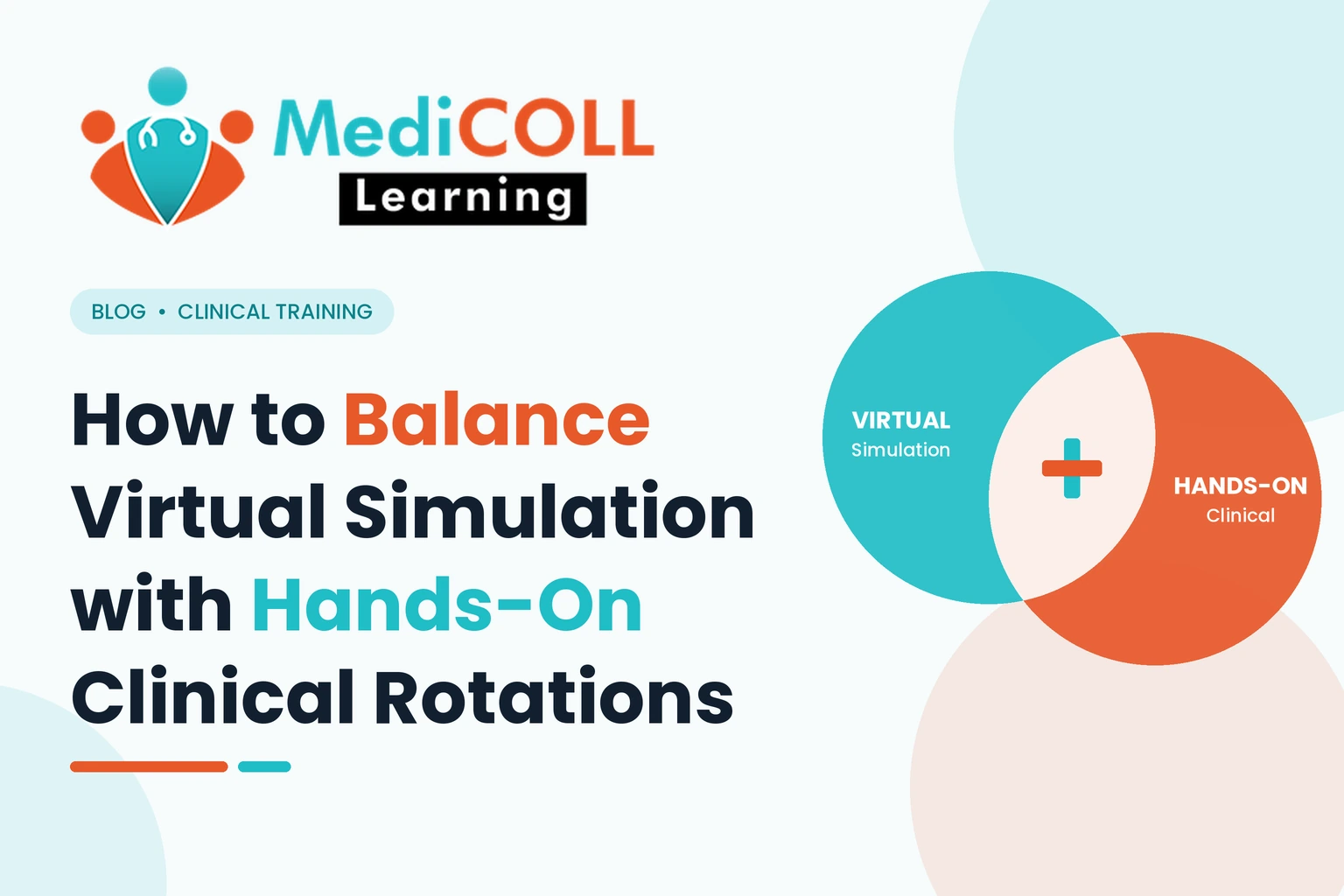
Simulation vs Clinical Training is best understood as a question of what each method does well. Simulation offers repetition, safety and standardisation. Clinical settings like hospitals offer realism, variability and accountability. A trainee who relies on only one of them develops an uneven profile, either technically polished but untested in real conditions, or experienced but with gaps in procedures that the posting never happened to include. Neither method is sufficient on its own, and the proportion between them is the part of training that a learner can actually adjust.
Clinical Skills Training for Medical Students is most efficient when the share of simulation falls as responsibility rises. In the early clinical years, simulation carries a larger part of the load. Examination technique, basic procedures and history taking can be rehearsed on mannequins and with standardised patients before a first real encounter with patients, which spares patients with the earliest and least polished attempts.
Internship is the period when the trainee carries real responsibility, so supervised procedures and case management come first, with simulation reserved for team-based emergencies and refreshers on procedures performed infrequently.
For practising doctors who wish to upskill and enrol in a course, the useful step is to identify the areas where clinical exposure has been thin and to look for a structured way of closing that gap, such as a programme that includes supervised clinical training.
During the first years of postgraduate practice, simulation remains useful for refreshing procedural skills, practising uncommon emergencies and strengthening team-based decision-making. However, clinical experience and supervised management of real patients should increasingly guide professional development.
Hands-On Clinical Training turns what a trainee has practised on a simulator into a skill that holds up with a real patient. The same applies to practising doctors who move into a new area of specialty to gain exposure and expertise, for example through hybrid fellowships.
Supervised clinical training provides first-hand exposure to real patient scenarios. Guidance from experienced clinicians helps learners identify gaps, correct mistakes and develop their clinical skills while maintaining patient safety.
Blended Learning in Medical Education combines various methods like simulation, lectures and clinical rotations, with each used for what it does best. MediCOLL’s fellowships are designed to give practising doctors supervised work with real patients, alongside online classes that cover the theory.
Each fellowship follows a hybrid format, with 10 months of online classes followed by 2 months of clinical training at a super specialty hospital. The programmes are affiliated with the NHS, eIntegrity, the University of Liverpool and Mangalayatan University, and are CPD accredited.
Clinical Training for Medical Students works best when simulation prepares the learner and the bedside confirms the skill. Simulation gives safe repetition and feedback, while supervised clinical training gives the judgement that only real patients can teach.
Students, interns, junior doctors and practising doctors who use simulation to prepare, gain supervised exposure to real patients and review their practice afterwards are likely to be better prepared for independent practice, and hybrid fellowships offer a structured route to that exposure.
Medical Simulation Training uses lifelike equipment, virtual environments, and role-playing to let healthcare providers practice clinical skills safely
No, the available evidence does not suggest this. Simulation improves skill acquisition when it is combined with feedback and deliberate practice, but its realism is partial and the transfer of skills to real patients is uncertain. It works best as preparation before a posting.
Judgement when information is incomplete or conflicting, communication with distressed patients and relatives, working within a live team, and hand-overs. These depend on variability that scripted scenarios seldom contain, so Hands-On Clinical Training remains the main route for them.
Yes. If the fellowship includes a supervised clinical component such as offered by MediCOLL Learning. A format with online classes followed by clinical training at a hospital allows theory and bedside practice to be covered in sequence.
© Copyrights Medicoll All rights reserved.