| Blog Summary |
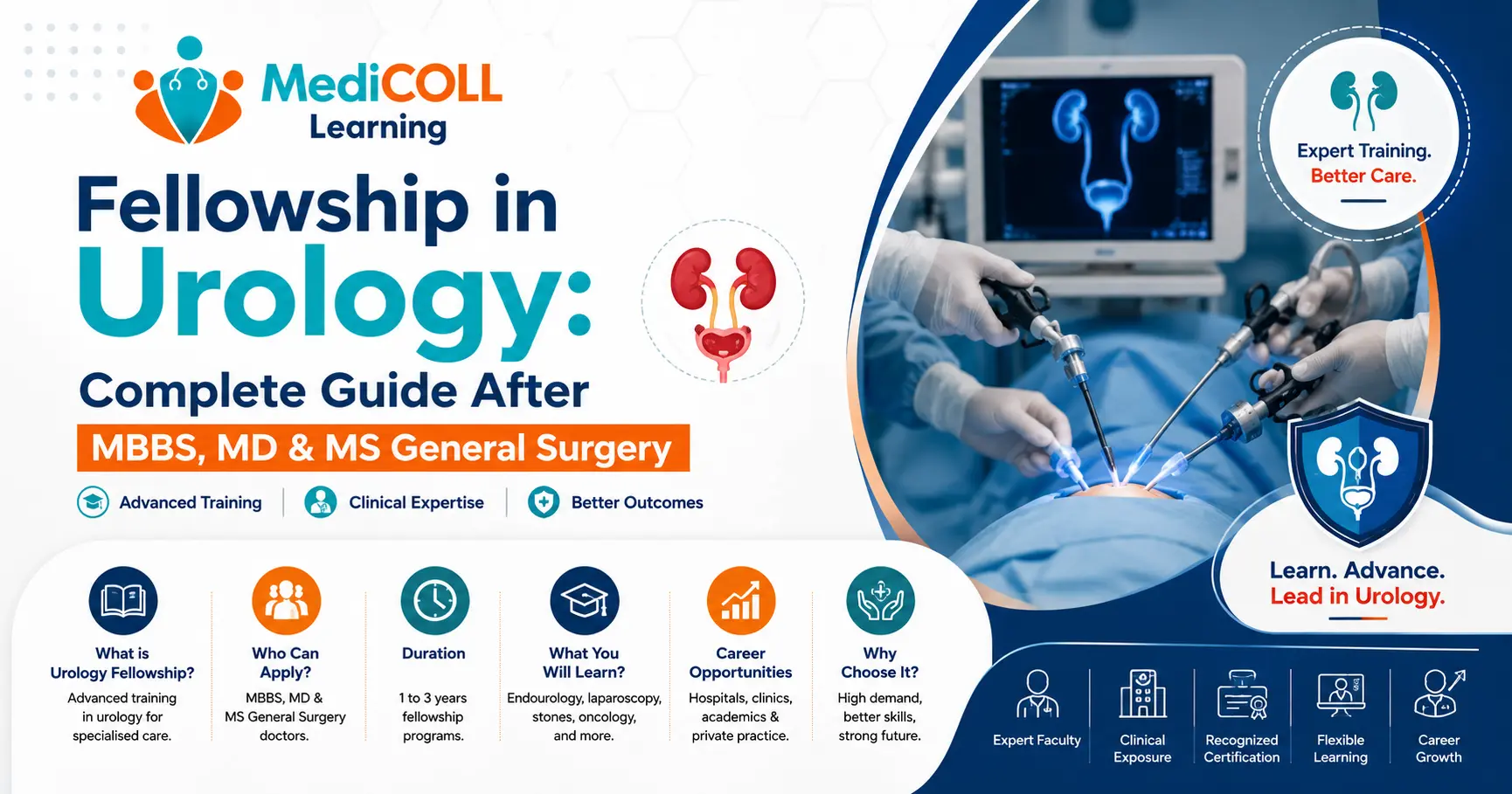
| Urology as a specialty requires precision, technical skill, and dedicated postgraduate training to provide the best patient care. A Fellowship in Urology in India gives doctors the clinical knowledge and experience needed to practice independently. This blog explains eligibility, duration, fellowship structure, career scope, and how to choose the right institute for advanced urology training. |
Urology is one of the most technically demanding surgical specialities and covers conditions related to the urinary tract and male reproductive system. The need for urology specialists is rising as patient complexity grows and surgical techniques continue to advance.
A Fellowship in Urology provides doctors with focused medical training and clinical exposure to real world settings. It helps doctors establish independent specialist practice and deliver high quality care. For doctors looking to build a career in urology, a fellowship program is one of the most important steps toward specialising in urology while simultaneously continuing their clinical practice, as most fellowship programs nowadays offer blended learning options.
A Fellowship in Urology is a post graduate medical program designed to provide advanced training in urological conditions. It focuses on the diagnosis and management of disorders affecting the kidneys, bladder, prostate, urethra, and male reproductive organs.
A urology fellowship is mostly practice based so that doctors can build a strong clinical foundation that helps in early identification and intervention. Fellowship pursuing doctors work alongside experienced urologists, assist in clinical procedures, manage outpatient cases, and develop the clinical judgment needed for better patient care.
|
Feature |
Details |
|---|---|
|
Program Name |
Fellowship in Urology |
|
Program Level |
Postgraduate Fellowship |
|
Duration |
12 Months |
|
Learning Mode |
Online live classes + clinical training at a multispecialty hospital |
|
Eligibility |
MBBS / MD / MS / DNB / FNB / Medical Residents / AYUSH practitioners |
Trusted online fellowship programs are often accredited by recognised national or international medical educational authorities including NHS approved and MCI approved institutions such as:
Completing the program successfully earns participants a certificate of Fellowship in Urology, which adds professional credibility and reinforces their clinical expertise.
Fellowship in Urology in India has grown significantly over the past few decades. The demand for trained urology specialists across the country is high with rising cases of kidney stones, urological cancers, prostate disorders, and urinary tract infections.
Several medical institutes and hospitals are now offering training programs like urology fellowship across India. These fellowship programs differ in duration, mode of delivery, and curriculum depth.
Some fellowships are purely clinical and institution based while others follow a blended format combining online learning with clinical training. This makes the fellowship more accessible for working doctors across different geographic areas based on the interest and availability.
Fellowships usually cover a range of urological conditions in the curriculum including kidney disorders, urological cancers, pediatric urology, and minimally invasive endoscopic procedures
The eligibility criteria for Fellowship in Urology in India includes:

Fellowship in urology is generally 1 to 3 years in India. The duration of the fellowship program varies depending on the institute and program format. The length of fellowship also depends on the depth of curriculum and the specific area of urology being covered.
Common fellowship lengths are:
Most one year fellowship programs follow a hybrid format consisting of online classes followed by clinical training in a multispecialty hospital under the supervision of experienced urologists.
Some key reasons doctors pursue the fellowship are:
A urology fellowship for MBBS graduates is a way to build a foundation in the speciality early in their professional career. The curriculum starts with anatomy and moves through imaging, stones, infections and common urological presentations, which helps new graduates recognise these problems in everyday practice. It also gives those still deciding on a speciality a clear idea of what urology usually involves.
MD holders, particularly those in general medicine, regularly see patients with haematuria, renal colic, urinary infections and kidney problems. A urology fellowship builds on that experience and helps in deciding when a patient needs to be referred to a urologist.
A fellowship in urology after MS General Surgery builds on the surgical foundation that general surgeons already have, adding urology-specific content. For those drawn towards urological work, it is a practical step in that direction.
DNB and FNB holders from related specialities, such as general surgery or general medicine, often come across urological cases in their own practice. The fellowship gives them a focused understanding of how these cases are investigated and when specialist input is needed.
The curriculum of fellowship in urology at MediCOLL focuses on the diagnosis, imaging and management in urology. The goal is for doctors to understand how a urological problem is investigated, how it is staged or classified, and what the next step in management should be.
The curriculum is organised around these areas:
Anatomy of the genito-urinary tract: A systematic look at each organ, from the kidney down to the penis, along with the adrenal glands.
Choosing the right institute for a Fellowship in Urology in India is an important decision for doctors as it can shape the direction of a career. A few factors to consider while selecting a fellowship are:
Accreditation and recognition of the program - The program should be recognised by a reputed medical body or institution
Curriculum depth - Ensures that the curriculum of the fellowship program covers the areas of urology relevant to the area of clinical practice
Mode of delivery - Mode of delivery is an important factor to keep in mind while checking the fellowships. Hybrid training programs work better for doctors who do not wish to pause their clinical practice
Faculty experience - Learning under experienced urologists makes a significant difference as it helps in gaining clinical insights from real patient cases.
Program duration and flexibility - This is one of the essential factors to note. It is always beneficial to choose a duration that fits the career stage and availability
The best fellowship in urology is not always the longest or the most expensive one. The right program is the one that provides meaningful clinical experience, aligns with clinical goals, and fits the current stage of practice.
The career opportunities after completing a urology fellowship in Delhi or anywhere in India are broad. Doctors can work in multispecialty hospitals, set up independent urology clinics, join academic institutions, or do research in the urology.
Trained urologists are needed in urban and rural healthcare settings with the rising burden of urological conditions in India. A Fellowship in Urology in India adds value to a profile and contributes to overall professional growth of a doctor
MediColl is one of the eminent organizations which offer a Fellowship in Urology. It is designed by medical experts who have years of clinical experience keeping in mind the schedules of working medical professionals. The program follows a blended learning format and combines online academic modules with clinical training at multispecialty hospitals.
The curriculum is built around practical clinical application. It covers essential areas of urology in a format that fits around a doctor's existing practice commitments. MediColl stands out for doctors searching for the best fellowship in urology that balances flexibility, clinical depth, and recognised certification.
A fellowship is worth applying for only if it fits a doctor's needs and career goals.
For doctors who want to strengthen their urology knowledge in a short time, a fellowship is a practical option. It takes less time than a postgraduate degree and does not involve an entrance exam. A general practitioner or a doctor with an MD who regularly sees patients with stones, haematuria or urinary infections can use the fellowship to build a firmer base in urology.
Also because the programme is usually blended, working doctors do not need to step away from their clinical duties. Its value depends on the recognition it carries, whether it includes clinical training and how well the curriculum fits the doctor's own work.
However, for those aiming to become urologists with a formal super-specialty qualification, the route is MCh or DrNB.
| Factor | Fellowship in Urology | MCh Urology | DrNB Urology |
|---|---|---|---|
| Purpose | Focused additional training in urology | Formal super-specialty degree in urology | Formal super-specialty training under the National Board |
| Duration | Usually 1 to 3 years, depending on the programme. MediCOLL's runs for 12 months. | 3 years | 3 years |
| Admission and Eligibility | Set by the institute. Open to MBBS graduates, MD/MS and DNB/FNB holders, AYUSH practitioners and residents. | Requires MS or DNB in General Surgery, with entry through NEET-SS. | Requires MS or DNB in General Surgery, with entry through NEET-SS. |
| Clinical Exposure | Varies by programme. MediCOLL's includes two months of supervised training in a multispecialty hospital after ten months of live sessions. | Full-time, hands-on training in a teaching institution. | Full-time, hands-on training in a board-accredited hospital. |
| Qualification | Certificate of fellowship. The fellowship by MediCOLL is described as accredited by bodies such as eIntegrity and the NHS. | Super-specialty degree recognised by the NMC. | Doctoral-level super-specialty qualification from NBEMS. |
| Best Suited For | Doctors who want focused urology skills, often while continuing their current practice. | MS General Surgery graduates aiming for a formal urologist qualification. | MS or DNB General Surgery graduates aiming for the same through the National Board. |
A Fellowship in Urology is a significant step for a doctor looking to build focused expertise in this growing speciality of medicine. A fellowship provides the clinical foundation needed for better patient care for MBBS graduates just starting out as well as post graduates like MS General Surgery holders looking to move into urological care.
With several training programs now available across India including flexible blended options, doctors now have more choices for upskilling and improving clinical competency. Pursuing a urology fellowship after general surgery or other medical fields has become a practical way to grow and advance in the medical career.
A Fellowship in Urology is a post graduate training program that provides advanced clinical knowledge and skills to the doctors. It includes diagnosis, treatment and management of disorders related to kidneys, bladder, prostate, urethra, and male reproductive organs.
The duration of the fellowship ranges from one to three years. The duration depends on the institute, program format, and area of specialisation. One year blended programs are popular among working doctors as it combines online learning with clinical training.
The fellowship is open to MBBS graduates, post graduates like MD and MS holders. DNB and FNB holders, AYUSH practitioners, and current medical residents can also apply for the fellowship.
Yes. Doctors with an MS in General Surgery can apply, and the fellowship builds on their surgical background with urology-specific training.
Yes. MD holders can apply, as can any doctor who has completed MBBS and holds a valid medical registration.
It depends on the institute. MediCOLL's Fellowship in Urology includes two months of supervised clinical training in a multispecialty hospital, which follows ten months of live sessions with the teaching faculty and the final assessment.
After completing the Fellowship in Urology, doctors can work in hospitals and clinics. Those interested in research or academics can also take up roles in urology.
The choice depends mainly on career goals and how much time a doctor can set aside for studying. Accreditation, curriculum, length, mode of delivery, faculty and whether clinical training is included are the other points worth comparing.
No, the two serve different purposes. A fellowship is focused training that is shorter in length. MCh and DrNB Urology are full-time super-specialty qualifications, usually taken after an MS or DNB in General Surgery, and they are the route for doctors aiming for a formal urologist qualification.
© Copyrights Medicoll All rights reserved.