| Blog Summary |
|---|
| Medical fellowship trends for MBBS doctors are shaped by blended learning, in-demand specialties, technology-enabled training and changes in NMC diploma pathways. This article examines these developments, explains the postgraduate training options available after MBBS, outlines key factors for evaluating a fellowship programme, and reviews courses across six clinical areas that may support doctors’ professional development and career progression. |
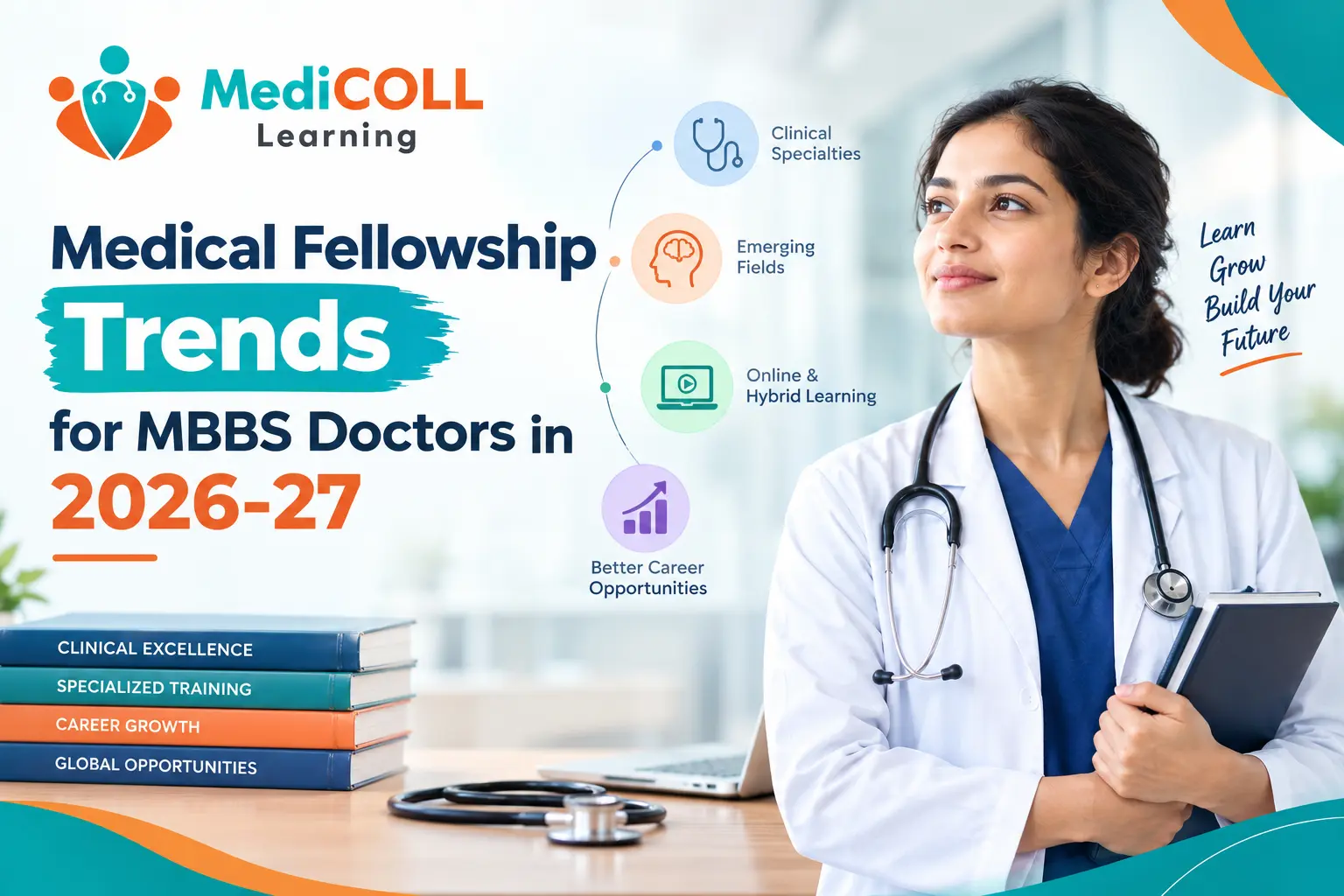
Fellowship training has now become an established step for many clinicians. The interest in fellowship training is shaped by hospital requirements, growing demand for specialised clinical services and the availability of hybrid and online learning formats. These formats have made structured training more accessible to clinicians who wish to continue their education alongside their clinical commitments.
The year 2026-27 also brings a regulatory change relevant to every doctor weighing the available routes, as the National Medical Commission (NMC) has announced that medical college PG diplomas will cease after the current admission cycle. Medical fellowships after MBBS in India therefore warrant assessment of format, recognition and clinical content together before a doctor enrols in a course.
The most consistent development is a move from full-time offline fellowships to hybrid formats, in which theory is delivered online and hospital exposure is condensed into a period of supervised training. Residential training formerly required a doctor to step away from clinical work for six months to two years, which, for a number of practical and financial reasons, placed structured training out of reach for many clinicians.
Features such as recorded lectures, live case discussions and online simulation now carry the theoretical content, while a few weeks of clinical training under supervision at a partner hospital provides opportunities to strengthen clinical assessment and develop practical skills. Fellowship courses after MBBS built on this model suit doctors who cannot take extended leave from clinical work.
Hospital demand follows disease burden, and the specialties with the heaviest clinical load show the most consistent need for fellowship-trained clinicians. Critical care and emergency medicine continue to attract interest because of rising patient acuity and the need for ICU and triage competence outside tertiary centres.
Cardiology and diabetes follow the burden of non-communicable disease, and as per the ICMR-INDIAB study published in The Lancet Diabetes & Endocrinology, an estimated 101 million people in India live with diabetes, with a further 136 million at the prediabetes stage.
Family medicine is gaining ground as primary care moves towards prevention and continuity of care, and dermatology remains well established in practice. Fellowship programs after MBBS in these areas are best weighed against local patient mix and the intended practice setting, since these determine how much of the training is applied in daily work.

Training content now reflects the tools in routine clinical use. Point-of-care ultrasound, tele-consultation workflows, electronic records and decision-support software feature increasingly in curricula, and image-intensive specialties are adding AI-assisted interpretation.
Hospitals adopting robotic surgical systems, teleradiology and algorithm-based diagnostic tools are also influencing the skills and technological competencies expected of. For the clinician, the practical consequence is that digital competence is assessed alongside clinical reasoning, and a course with no exposure to these tools may soon appear dated.
Read Also: Flu, COVID, or Dengue? How to Tell the Difference in Symptoms This Season
Recognition has become the criterion on which courses are most often compared. In June 2026 the NMC announced that PG medical diplomas offered by medical colleges will be discontinued, with 2026-27 as the final admission year, and that colleges may convert diploma seats into MD and MS seats. The decision applies only to these college-run diplomas and does not extend to every diploma or postgraduate qualification in India.
The NBEMS post-MBBS diplomas form a separate pathway, offered in nine broad specialties such as family medicine, anaesthesiology and emergency medicine, and NBEMS clarified in July 2026 that the NMC notice does not pertain to them.
Statutory options after MBBS are therefore fewer, and a fellowship is best regarded as a skill-building course that supplements an existing qualification.
Many doctors also use a fellowship year to test a specialty before committing to a postgraduate attempt, which makes clarity about the status of the credential all the more important. Doctors should verify what a provider’s partners and credits actually represent, and should be cautious of titles that imply a registrable specialist qualification.
A few practical checks separate the best fellowship courses for MBBS doctors from other certifications available in the education market.
MediCOLL Learning offers a wide range of fellowships in multiple areas of medicine. Six of its high-demand courses are Critical Care, Emergency Medicine, Clinical Cardiology, Diabetes Mellitus, Family Medicine and Dermatology, which correspond to the areas of demand described above.
All the fellowships offer a hybrid approach and are designed by experienced clinicians with curricula updated regularly to reflect current clinical practice. Medical fellowship programs in India of this type are most valuable when the structure suits ongoing clinical responsibilities, and these fellowships run for 12 months with 10 months of online classes followed by 2 months of supervised clinical training at a super specialty hospital.
They are affiliated with NHS, eIntegrity, the University of Liverpool and Mangalayatan University, and carry CPD accreditation. The courses are intended for doctors who wish to add specialty depth to an existing qualification, and completion adds value to the professional profile while reflecting the doctor’s commitment to continuous professional development.
Medical Fellowship Trends for MBBS Doctors in India are evolving, shaped by changing educational formats, clinical requirements, technological developments and regulatory changes. For doctors considering additional training after MBBS, the priority should be to evaluate the curriculum, supervised clinical exposure, faculty expertise, assessment methods, awarding bodies and credentialing arrangements before selecting a course. A well-chosen fellowship can support continued learning and professional development, provided its scope and limitations are clearly understood by the doctor before enrolment.
Fellowship courses after MBBS which are sought-after include critical care, emergency medicine, clinical cardiology, diabetes, family medicine and dermatology among other specialties. This is mainly because patient numbers in these fields exceed the trained clinicians available.
Yes, the blended courses can offer the flexibility to study while simultaneously working. These courses are a combination of online classes and supervised clinical training, which is why hybrid fellowship training for doctors in India suits clinicians who would like to continue their clinical practice with professional upskilling.
Yes. Fellowships offered by private providers, hospitals and online platforms do not require NEET PG for admission, and an MBBS degree with valid NMC or State Medical Council registration is usually the main requirement.
Fellowship programs after MBBS add structured specialty exposure that employers can assess, but the overall effect on employment depends on the clinical experience, qualification and requirements of that position.
© Copyrights Medicoll All rights reserved.