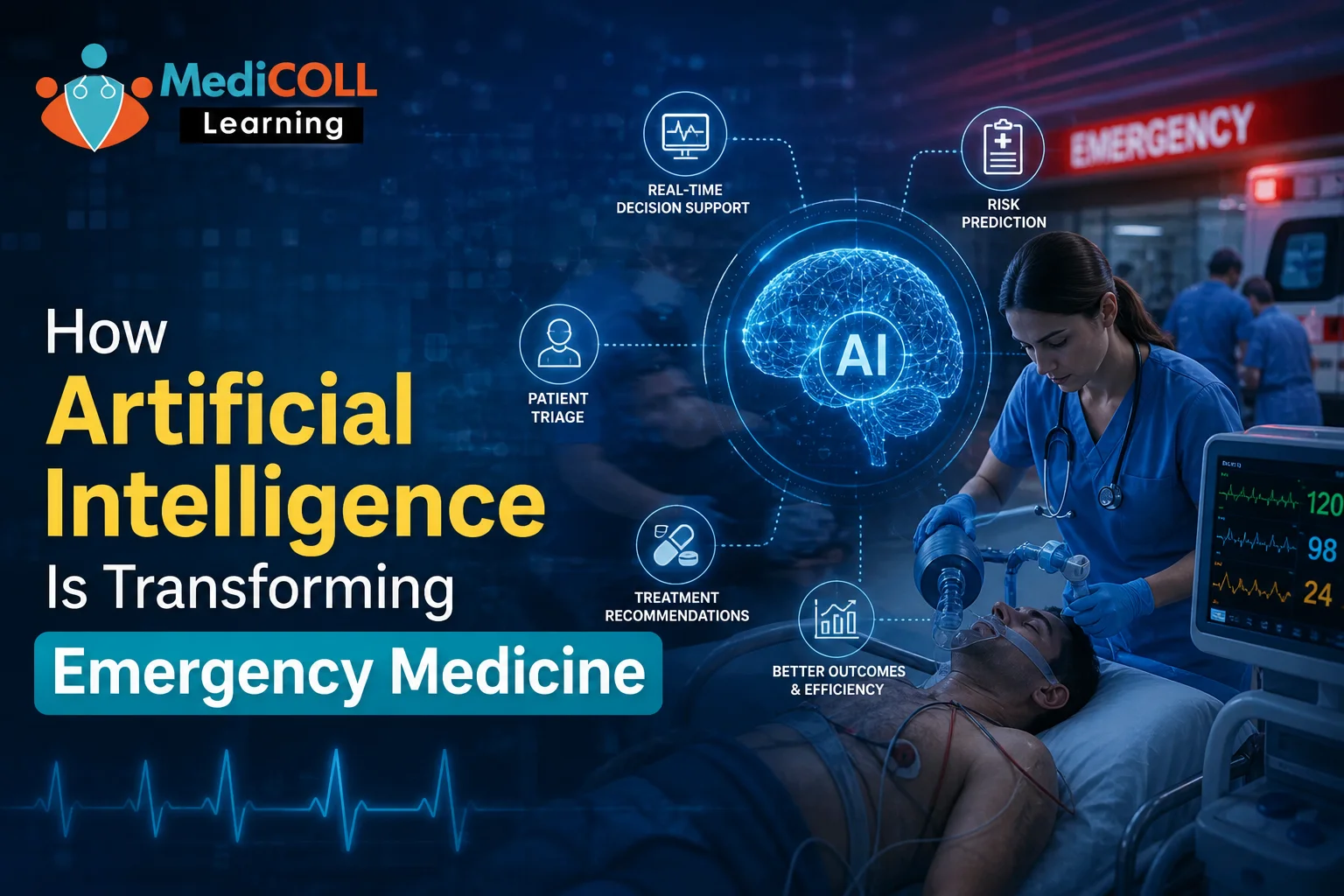
Artificial intelligence in emergency medicine is changing how doctors diagnose, prioritize, and treat patients, faster and more accurately than before. Emergency departments (ED) run on pressure and every minute matters. A missed finding or a delayed triage decision can change a patient's outcome entirely. That is where artificial intelligence (AI) is stepping in, not to replace clinicians but to support them at the critical moments where early intervention matters most.
The role of AI in emergency medicine has grown considerably over the past few years. Artificial intelligence (AI) systems now assist with patient triage, clinical decision support, imaging review, and real-time monitoring across emergency departments (ED) globally.
One consistent gap in emergency care is decision speed under pressure not clinical knowledge. AI addresses this directly. It processes patient data at a scale no single clinician can match and flags what needs immediate attention.
According to a 2024 report by the American College of Emergency Physicians, around 52 percent of emergency departments in the United States have integrated some form of AI-assisted support into their clinical workflows. This number continues to grow as more departments recognise the clinical value artificial intelligence (AI) brings to high-volume care settings. Consequently, hospitals that have adopted these tools report measurably improved patient care and clinical efficiency.
AI in emergency diagnosis works by analyzing multiple data streams at once. This includes vitals, laboratory values, ECG patterns, imaging findings, and patient history. Additionally, help to surface the most likely diagnoses within seconds.
For instance, AI-powered ECG interpretation tools can detect STEMI with accuracy. Specifically, machine learning models trained on large cardiac datasets have shown sensitivity above 90% for identifying acute coronary events. The sensitivity was around the same percentage even in early or atypical presentations. This matters in the emergency department because atypical presentations are common and time to catheterization directly affects patient outcomes.
Artificial Intelligence also reduces anchoring bias. Clinicians sometimes fix on an early clinical impression and do not adjust quickly enough. Artificial intelligence (AI) recalculates continuously as new data comes in, which keeps the differential broad until the picture becomes clear.

Several AI applications in emergency medicine which are already in active clinical use today are:
All the above AI applications in emergency medicine reduces cognitive load during high-pressure situations. The emergency physician still has to make the final call on treatment of the patient but with better information and in less time.
AI in trauma care is one of the most rapidly advancing areas in emergency medicine. Trauma patients arrive with incomplete histories, unstable physiology, and time-critical injuries. This is precisely where AI adds the most value.
AI systems in trauma settings assist with predictive analytics to flag deterioration early, real-time resuscitation support to guide fluid and transfusion decisions, prehospital triage to prioritise incoming cases before arrival, and postoperative monitoring to track recovery in high-risk patients. It compresses the time between patient arrival and definitive action. In polytrauma, that compression is clinically significant.
The benefits of AI in emergency medicine are both clinical and operational. They affect patient outcomes, workflow efficiency, and clinician performance under pressure.
From a clinical standpoint, AI enables earlier identification of time-sensitive conditions like stroke. It reduces diagnostic error rates and supports more consistent triage decisions. Operationally, the benefits of AI in emergency medicine include shorter wait times for the patients, reduced overcrowding through better patient flow prediction, and fewer unnecessary admissions.
For clinicians, AI reduces documentation burden, provides cognitive support during high-volume periods, and delivers early warning alerts that help prevent fatigue-driven oversights. These benefits are relevant in resource-limited hospitals. Facilities without round-the-clock specialist coverage can use AI tools to narrow the subspecialty gaps in radiological interpretation, ECG review, and patient monitoring.
The future of AI in emergency medicine is moving toward full clinical integration. The goal is for AI to function not as a separate tool but as a seamless part of the clinical interface.
In 2025 and 2026, several academic medical centers began piloting ambient AI systems that listen to patient encounters, generate structured documentation, and update risk scores in the background without interrupting the clinical workflow.
Artificial intelligence in healthcare is also reshaping how ED data connects with hospital-wide systems. Real-time AI dashboards now give hospital teams visibility into ED capacity, predicted admissions, and discharge bottlenecks. This enables proactive resource planning before a crisis develops.
The next phase involves multimodal AI, systems that integrate text, imaging, voice, and biosignal data together. For emergency medicine, this means a system that simultaneously reads a CT scan, tracks a troponin trend, processes the physician's verbal assessment, and surfaces the most evidence-aligned management options.
Pilot programs for this level of integration are already running. Artificial intelligence in healthcare is not a distant concept for emergency medicine. It is a present-day clinical reality, and it is advancing quickly. The role of AI will only deepen as institutions train their clinicians to work alongside these tools in emergency medicine with confidence and clinical judgement intact.
Artificial intelligence in emergency medicine means using machine learning, natural language processing, and computer vision to support clinical work. It helps in triage decisions, diagnostic support, patient monitoring, and real-time alerts alongside the clinical team.
Artificial Intelligence processes large volumes of patient data including labs, vitals, imaging, and history. It identifies patterns thereby reducing diagnostic delays and errors.
AI in emergency medicine is not replacing emergency physicians but functions as a decision-support tool. AI improves the speed and quality of information available to them. However, the emergency physicians have full decision-making authority.
The most widely used AI applications include triage and patient prioritization, rapid interpretation of diagnostic imaging (e.g., CT scans, X-rays), and predicting patient outcomes hours before symptom onset.
© Copyrights Medicoll All rights reserved.