| Blog Summary |
|---|
| Doctors are expected to learn a large volume of information and recall it accurately in practice. Adaptive learning platforms use learner data to personalise content, feedback and revision according to individual needs. This blog examines how these systems work, what current evidence shows, the risks involved, and what fresh graduates and practising doctors should consider when choosing a digital course. |
Medical knowledge keeps evolving with new guidelines, medicines and devices, and doctors at every stage are expected to know it correctly and recall it when a patient is in front of them. Recent attention has turned to AI in Medical Education, particularly to systems that adjust what a learner sees according to how that learner is performing. For most doctors the question is whether such technology helps them acquire information accurately and keep it. The sections below answer this question.
A conventional lecture series moves at one speed for every learner. A doctor who already knows pharmacology well spends the same time on it as a fresh graduate who does not, and neither receives feedback until an examination arrives. The learning gaps stay hidden for weeks, and incorrect understanding can settle in.
Adaptive Learning in Medical Education tries to remove this mismatch by measuring performance continuously and changing the sequence, difficulty and revision schedule for each learner. The aim of implementing AI is not to replace the traditional teaching methods but to make sure study time goes where the individual actually needs it.
Most adaptive platforms rest on a few ideas.
Machine Learning in Medical Education supplies the analytical layer, since algorithms study answers, response times and study patterns to predict where a learner is likely to struggle. Adaptive tests can also change difficulty in real time, which gives a more precise picture of progress than a single fixed paper.
Learners may spend less time on material they have already mastered, which reduces unnecessary cognitive load. For a working doctor, this can shorten the time needed to revise a familiar topic without lowering the standard expected.
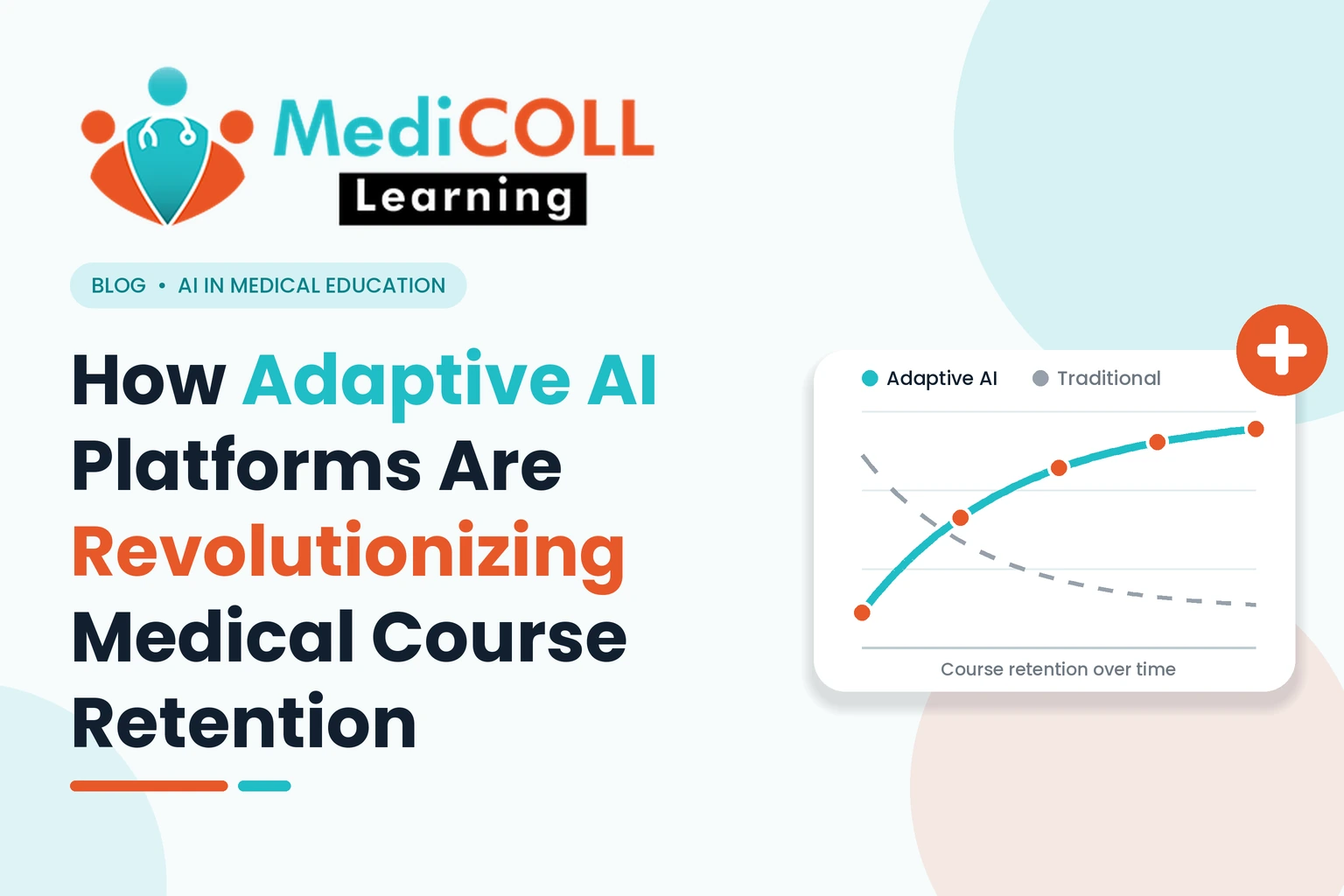
The evidence on AI in Medical Education is encouraging, with reservations. A 2026 systematic review and meta-analysis of 38 studies and 12,764 medical and healthcare learners found that AI-assisted learning improved academic performance and satisfaction. It also reported better educational engagement and more self-directed learning. However, it also lists limitations in the included studies, and these shape how far the results can be relied on.
This analysis combined studies that tested a wide range of interventions and measured outcomes in different ways, and few of those studies followed learners over the long term. Therefore, better test scores do not prove that doctors retain knowledge for years or apply it better at the bedside. AI-Powered Learning Platforms are best judged as promising aids to learning and skill updating, not as proven replacements for structured teaching.
Retention is useful only when what is retained is correct. Platforms that provide immediate, accurate feedback can help learners identify and correct misunderstandings before they become established. Chatbots and generative tools add convenience, but they can produce confident errors, and a learner who absorbs a wrong dose or a wrong diagnostic criterion carries it into practice.
AI-generated explanations should therefore be checked against standard textbooks and current guidelines, and a named faculty member should remain responsible for course content. Medical Education Technology works best when it supports verified material and when assessments test application as well as recall.
The learning needs of fresh graduates and experienced doctors differ, though the principles are the same. Fresh graduates are building a broad base and benefit from frequent low-stakes questions that expose weak areas early. Practising doctors have less time and more varied gaps, so they gain from content that skips what they already know and returns to what they have not used recently.
Precision approaches to continuing medical education aim to do exactly this, using performance data to recommend modules. AI-Powered Learning Platforms of this kind draw on learner analytics and longitudinal records to find knowledge and skill gaps, give feedback matched to each doctor, and build a personal study plan, whereas a fixed programme offers the same content to every participant.
Such courses can also make doctors familiar with AI-supported tools they are likely to meet in practice, such as diagnostic aids, and tailored pathways may help address differences in learning needs, although their effect on educational inequalities remains uncertain. The evidence for these claims in continuing education is still limited, so they are best viewed as a promising approach.
Digital Learning in Medical Education removes the need for travel or extended leave, which matters in India, where many doctors study alongside full clinical schedules. Early-warning analytics can further show when a learner is falling behind, so that support reaches that person before the course is abandoned.
Read Also: Top 10 Fellowship Courses for Doctors after MBBS in India
Several concerns accompany these systems. Learner data may include performance records and, where clinical cases or patient data are used, potentially identifiable health information, so privacy rules must be clear and consistently applied by the institution and by every technology vendor it works with. Machine Learning in Medical Education models trained on narrow datasets can carry bias into assessments. Heavy dependence on automated answers may weaken independent reasoning, and the cost of advanced tools can widen the gap between well-funded institutions and others.
Connectivity is a further issue in parts of India. Practical safeguards include human review of automated assessments, hybrid designs that combine technology with mentoring, and mobile-friendly delivery that works on modest devices and data plans. These controls are easier to build in from the start than to add later.
Not every useful course needs an adaptive engine. Doctors can ask a few direct questions. Who prepared and reviews the content, how often is it updated, can modules be revisited, and is progress checked through meaningful assessment?
Digital Education for Healthcare Professionals is often delivered through learning documents available online. These resources do not adapt automatically to the individual learner, but they allow self-paced study and repeated revision, which support retention when the content is accurate and well organised.
MediCOLL Learning provides fellowship and certificate programmes for healthcare professionals, which help them acquire expertise in their chosen field of interest. The fellowship follows a hybrid format, and the learning materials include SCORM modules, presentations and online lectures, among others. These features make Digital Learning in Medical Education practical for working professionals, who can study at their own convenience, and no relocation is required to develop an in-depth understanding of the subject.
Adaptive technology offers a reasonable way to improve how doctors acquire and retain information, provided the information itself is accurate. The evidence so far shows gains in performance and satisfaction, with little data on long-term outcomes. Fresh graduates and experienced doctors alike are likely to gain from learning that responds to their gaps, supported by faculty oversight, careful handling of data and sound content. Adaptive Learning in Medical Education should add to good teaching and not stand in for it.
Yes, Fresh graduates gain from frequent questions that expose gaps early, while experienced doctors gain from shorter, targeted revision. Both groups save time when content follows their performance.
Not without checking. The content these tools produce needs timely review by a subject expert. Generative tools can sound convincing while being wrong, so explanations on dosing, criteria or guidelines should be confirmed against a standard reference. Machine Learning in Medical Education is better suited to tracking progress and selecting revision topics than to acting as the final authority on a clinical fact.
No. Self-paced modules, recorded lectures, regular self-testing and spaced revision also support retention. Adaptive systems add personalisation, but accurate and well-organised content remains the foundation.
Data privacy, bias in algorithms, over-reliance on automated answers and unequal access are the usual concerns. Faculty review and clear data policies reduce most of the risks attached to Digital Learning in Medical Education.
© Copyrights Medicoll All rights reserved.