In recent years, medical education has changed quite a bit with the rise of digital learning. Traditional training is mostly classroom-based or hospital-based and often requires commuting or even relocation. With digital platforms, however, doctors can now learn from anywhere without having to move.
As digital learning becomes more accessible, many doctors are exploring flexible options to pursue further education. This has led to a common question “online vs offline medical courses, which one is better?” Both options have their own advantages, and the choice usually depends on individual needs, work schedules, and learning preferences of the doctors.
Medical fellowship programs are post graduate training courses that help doctors gain additional knowledge in a specific area of medicine. These programs are usually more focused and of shorter span compared to postgraduate degrees.
Doctors usually choose fellowships to improve their clinical skills, explore a particular field, or stay updated with current clinical guidelines. These programs offer online and offline formats. Both online and offline fellowships aim to provide learning, but the way they deliver it can be quite different.
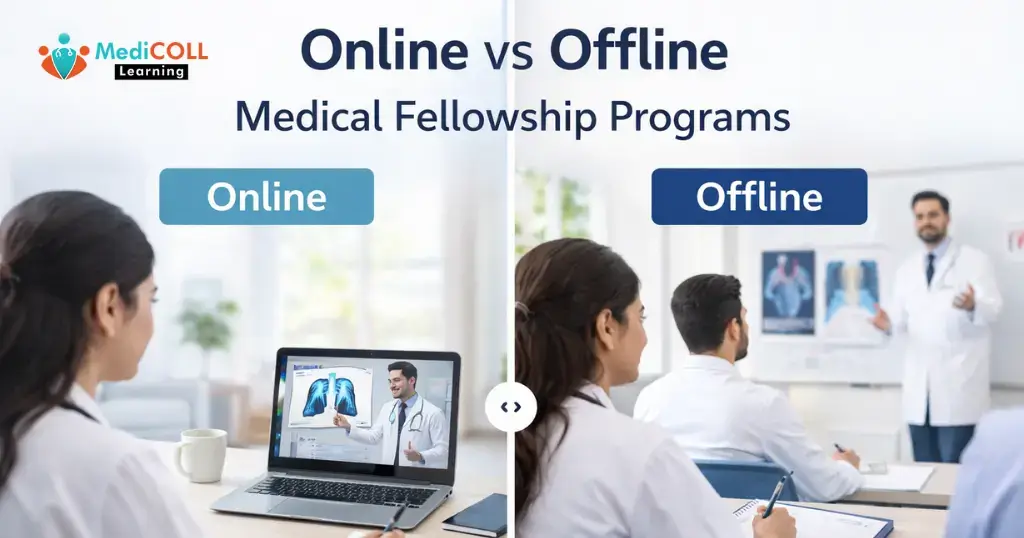
Online medical fellowship programs are designed for flexibility. Doctors can attend online classes; participate in discussions and access study material using digital platforms.
MediColl is one of the leading organizations which offer online fellowships to medical professionals to upgrade their clinical knowledge and support professional development. The fellowship follows a blended format of online live sessions with a senior physician and medical experts followed by clinical training in a multispecialty hospital under the mentorship of the experienced physicians to gain clinical exposure in a real world setting.
The study resources include interactive live sessions with medical experts, case-based discussions, and self paced modules which contain relevant essential topics which are aligned with updated clinical guidelines accessible on Learning Management System (LMS).
This allows doctors to learn at their own pace and convenience without needing to relocate. The hybrid format of the fellowship works well for practicing doctors to continue working while upgrading their knowledge at the same time.
On the other hand, offline medical fellowship programs are usually conducted in hospitals or academic institutions. These programs involve physical attendance and direct interaction with patients and faculty.
Doctors enrolled in offline programs also get hands-on clinical exposure, which helps in building practical skills. Being present in a clinical setting also allows for immediate learning from real cases. However, this format usually requires more time commitment and may not always be a suitable learning option for those who are already working full-time.

When it comes to comparing the both online and offline fellowships, there is no apt answer that fits one and all. Online programs offer flexibility and convenience. Doctors can learn without interrupting their clinical responsibilities and can access study material anytime. This is especially useful for those with hectic schedules.
Offline programs, on the other hand, provide more direct extensive clinical education. For doctors who prefer in-person learning, offline medical fellowship may be a better option. In most cases, the choice depends on what the doctor is looking for at that particular point of time.
One of the main differences in online vs offline medical courses is flexibility. Online fellowships allow doctors to study according to their convenience and pace. This makes it easier to balance work and learning and also reduces the need for relocation or travel.
Offline programs follow a fixed schedule. While this helps in maintaining discipline, it may be difficult for doctors who have ongoing clinical responsibilities. Learning style also matters for the medical professionals. Some doctors prefer self-paced learning, while others find classroom or hospital-based learning more effective.
Clinical exposure is another important factor when comparing online medical fellowship programs and offline ones. While pursuing offline programs, doctors can observe procedures, interact with patients, and learn directly in a clinical setting.
Online programs often include discussions of various clinical scenarios with a senior faculty to understand the management of the patients suffering from different medical conditions. Additionally, online fellowship helps in acquiring clinical exposure in hospitals. Online fellowships combine theoretical learning with clinical experience which can be useful when applied in real patient cases.
Time is often a deciding factor for doctors choosing between online fellowship for doctors and offline programs. Online fellowships are a more convenient path to pursue medical education. Doctors can learn alongside their work without taking a break from their clinical responsibilities. Offline fellowships may require full-time or part-time attendance, which can be challenging for working professionals. Nowadays, most doctors choose online options simply because they fit better into their daily routine.
Both online and offline medical fellowship programs can have significant career in their own ways. Both formats can help in improving clinical knowledge, building confidence, and handling patients more effectively. The overall value often depends on how the doctor applies the learning in clinical practice. The choice of format does not limit career growth, as long as the learning is relevant and applied in real-world settings.
Choosing between online vs offline medical courses depends on individual priorities of a medical professional. Factors such as flexibility and convenience play an important role to decide which mode of fellowship to pursue.
Online Fellowships have an added advantage of flexibility and convenience which enables practicing doctors to continue learning without interrupting work. Offline fellowships offer in-person learning and may require full or part time attendance. However, there is no right or wrong choice for selection of the fellowship. It depends on what works best for the doctor’s current situation and future professional plans.
The answer to the common question which might cross every medical professional “Online vs offline medical fellowship: which is better?” is that both formats have their own place in medical education.
Online programs offer flexibility and easier access to the study resources which can be an important factor for working professionals. Offline fellowships require physical attendance and classes are conducted at the hospitals or academic institutions. Understanding the differences between the two can help doctors choose a format that fits their needs.
© Copyrights Medicoll All rights reserved.