| Blog Summary |
|---|
| Dermatology remains one of the preferred postgraduate branches among medical graduates in India, and the pathway into it is well defined. Candidates must complete MBBS and the compulsory internship, qualify in NEET PG, secure a seat through counselling, and complete three years of postgraduate training. This blog explains dermatologist eligibility in India, entrance examinations, seat allotment, residency, and career opportunities. It also discusses how practicing doctors can enhance their existing qualifications through relevant fellowships. |
Demand for hair, nail and skin procedures has grown in recent years, and search trends reflect this. It is one reason dermatology is on the shortlist of a lot of MBBS graduates. The reasons are not always the same, though. For some it is the OPD and procedure mix, and for others it is the working hours, which are kinder than in surgery or medicine. The variety of conditions seen in the clinic, from acne and scabies to a psoriasis flare or a drug rash, is another reason some choose it as a specialty.
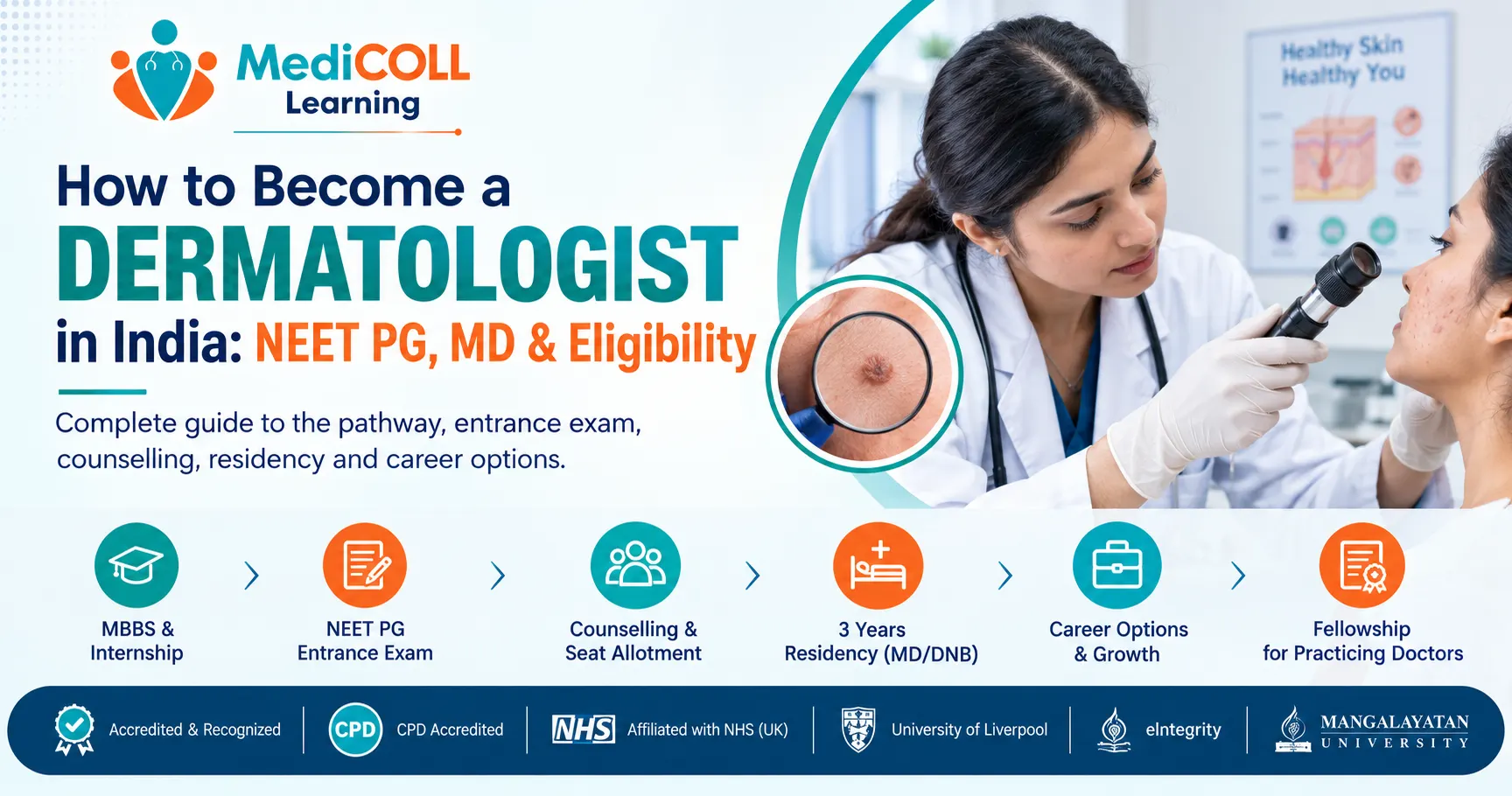
The question that comes next is always the same. How to become a dermatologist in India, and what has to be done first? For most candidates, the standard route to becoming a dermatologist in India is to qualify NEET PG and secure an MD or DNB seat through the counselling process.
The route from MBBS to postgraduate training has several steps, and they follow this order:
The examination dates and some of the rules change from year to year. For those asking what the standard dermatology course after MBBS is, it is the MD in Dermatology, Venereology and Leprosy. The DNB in the same subject is the other degree route, and some institutions also offer a two-year PG diploma.
In practice, a good part of the competition happens at the seat allotment stage and not only in the examination. Candidates should therefore prepare for more than the entrance examination. They need to know how the all-India and state quotas work, which documents are required and by when, how to build a sensible choice list, how the rounds run, and what happens if a deadline is missed.

It is imperative to understand that the eligibility should be confirmed before preparation begins. Dermatologist eligibility in India starts with an MBBS degree from a college recognised by the NMC as of the cut-off date it prescribes. The compulsory rotating internship must be completed, or be due for completion, by the date announced by NBEMS as it may change with each year.
Permanent or provisional registration with the NMC or a State Medical Council is also required. Foreign medical graduates, and overseas citizens of India (OCI) and NRI candidates, are subject to separate conditions and should read the official information bulletin closely. It should be noted that appearing in the examination does not confer any right to admission. It only allows the candidate to enter the selection process.
MD Dermatology eligibility, in practical terms, means qualifying NEET PG entrance examination and then securing a seat in counselling. The qualifying percentile has generally been the 50th for the general category, the 45th for candidates with benchmark disability, and the 40th for the reserved categories.
In recent cycles the percentile was reduced during counselling in order to fill vacant seats, but candidates should not plan on this happening again. Dermatology is a competitive branch, and a qualifying score alone seldom results in a seat. The final outcome depends on the candidate’s rank, category, quota and choice of college, and closing ranks differ from one year to the next.
Once the result is declared, the allotment process begins. The dermatology PG admission process generally involves qualifying NEET PG and securing a seat through the applicable counselling process. NEET PG is the single entrance examination for MD/MS and PG diploma admissions covered by the examination, subject to the specified institutional exceptions.
A small number of institutions fall outside this arrangement, and candidates should refer to the bulletin for these. The Medical Counselling Committee handles the 50 percent all-India quota, along with deemed and central universities and the Employee State Insurance Corporation (ESIC) and armed forces institutes. State authorities allot the remaining state quota seats.
The candidate registers, pays the fee, locks the choices of college and branch, waits for the allotment, and reports to the allotted college with the required documents. There are usually a few rounds, followed by a stray round. Choice filling needs particular care. A well-planned list places dermatology first and includes a few realistic alternatives below it.
The MD Dermatology course duration is three years of full-time training. The DNB is also of three years, and the PG diploma, where offered, is of two. Residents work across the outpatient department, the wards, the procedure room and the laboratory. The clinical exposure includes acne, eczema, psoriasis, fungal infections, leprosy, vitiligo and a large number of cutaneous drug reactions.
Over the course, residents also gain working knowledge of dermatopathology, phototherapy and minor surgical procedures, and learn to counsel patients with long-standing conditions. A thesis forms part of the degree.
A stipend is paid during residency, and the amount differs between states and between government and private colleges. Bond conditions and service rules also vary, and these should be read before a seat is accepted.
The dermatologist career in India offers more than one direction after the degree. Some doctors join government hospitals or medical colleges and move towards teaching. Others take up consultant positions in corporate hospitals. A considerable number set up a private clinic, either independently or in partnership.
Many include cosmetic procedures such as lasers, peels, fillers and hair treatments in their practice, since a large part of private demand lies there. Academic and research positions are also available, as are roles in pharmaceutical companies and clinical research organisations. Location has a clear influence on practice.
The honest answer on dermatologist salary in India is that income varies widely and cannot be reduced to a single figure. A resident receives a stipend, a salaried consultant receives a monthly package, and a private practitioner earns according to the patient load of the clinic.
Published estimates differ considerably between sources, and no single number should be relied upon. Experience, city, type of institution, procedural skills and patient volume all affect the final figure. In the early years a new practice is still establishing itself, and income usually rises as patients return and refer others.
Not every doctor is in a position to take the NEET PG for dermatology or other areas of medicine at the time for various reasons and circumstances.
Some doctors are already working, with clinic hours, hospital duties and other commitments to manage and there are also doctors who hold an MD and often want to develop deeper knowledge in one area.
For both groups, a fellowship is a practical option to pursue as an additional qualification that sits alongside the existing degree. It offers structured learning in a particular field of medicine while the doctor continues to practise clinically. For instance, a general practitioner who sees patients with skin complaints daily can build a firmer base in diagnosis and first-line management without stepping away from the practice.
A doctor who already holds a postgraduate degree can use it to study one area in more depth and carry that knowledge into further courses later. MediCOLL Learning offers a fellowship in dermatology for medical professionals that runs for 12 months in a hybrid format. The blended approach consists of online classes with experts, followed by clinical training in a multispeciality hospital under the guidance of experienced doctors. The fellowship is recognised and accredited with major authorities like the NHS and eIntegrity. It is a step that can add value to the existing professional profile.
Put simply, the answer to how to become a dermatologist in India is NEET PG. A small number of institutions are outside this arrangement, and each publishes its own rules, which should be checked directly.
Yes. A fellowship is designed for this kind of schedule and allows the doctor to study alongside current work.
The MD Dermatology course duration is three years of full-time training after a seat has been allotted. During this period the resident works in the outpatient department, the wards and the procedure room, completes a thesis, and appears for the final examination.
Both are recognised postgraduate routes of the same duration. Candidates usually decide on the basis of the seat obtained, the training available and the place they wish to work in.
Dermatologist eligibility in India requires an MBBS degree recognised by the relevant authorities, completion of the compulsory rotating internship by the prescribed cut-off date, and valid permanent or provisional registration with the NMC or a State Medical Council. Candidates must also meet the applicable NEET PG and admission requirements.
© Copyrights Medicoll All rights reserved.