| Blog Summary |
|---|
| The Medical Council of India (MCI) regulated medical education for more than 80 years before being replaced by the National Medical Commission (NMC) in 2020. This guide explains why the transition took place, highlights the key differences between MCI and NMC, and covers changes in medical education, governance, the NEXT exam, fee regulation, and medical college oversight. It also helps medical students and doctors understand how these reforms impact their education, licensing, and future career in India. |
If you trained before 2020, or you're still catching up on how Indian medical regulation works, you've probably come across both names and wondered which one actually applies to you now. NMC vs MCI isn't just an exam-time question anymore. It comes up when doctors apply abroad, when students check college recognition, and when practitioners try to understand which regulatory body now governs medical education and professional registration. Here's an explanation to all those questions.
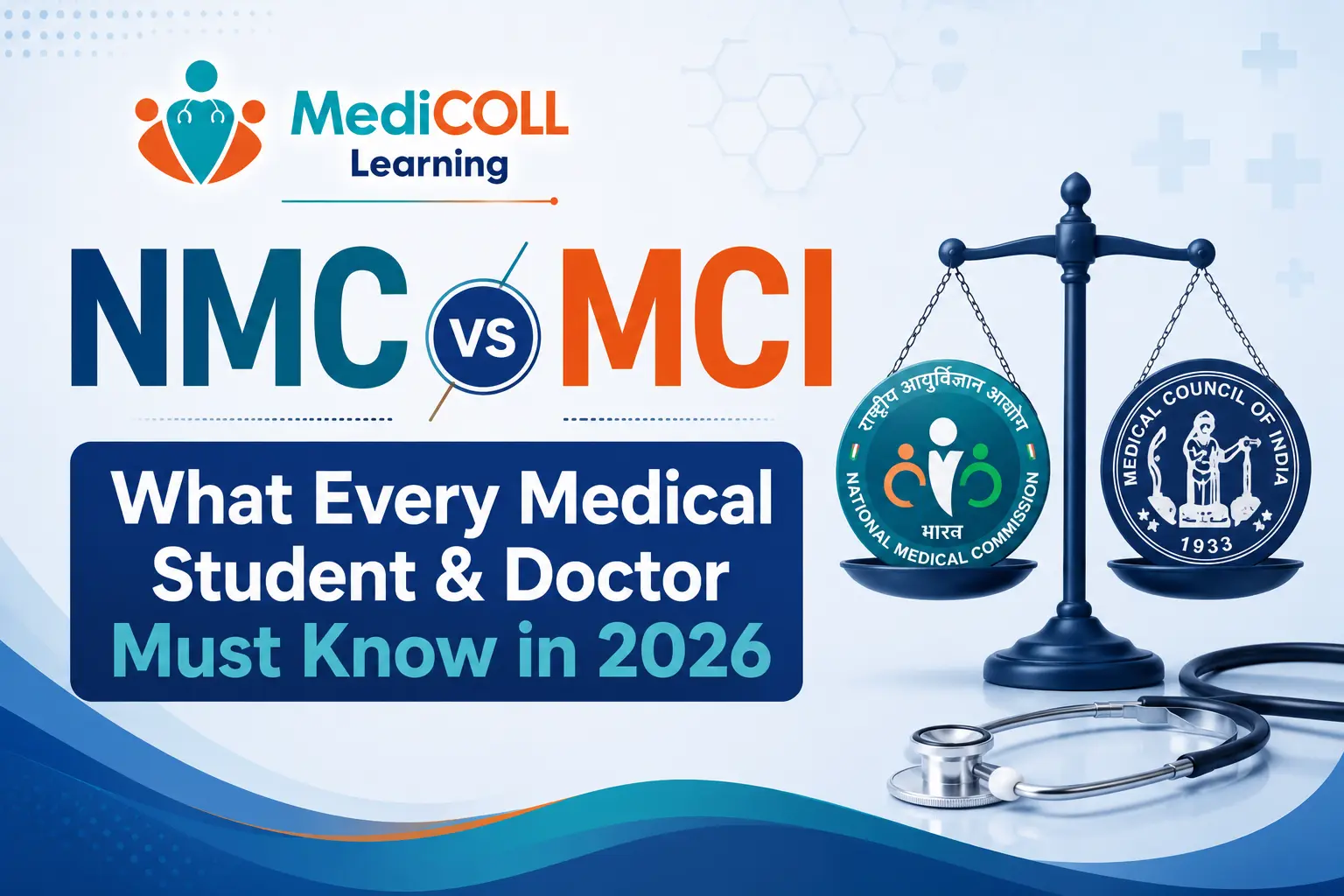
The MCI is the Medical Council of India. It was the regulatory body for medical education and practice in the country from 1934 right up to 2020. The full form of NMC is National Medical Commission, and it's the body that took over from the MCI, functioning since September 2020. So, to simply put they are different organisations at two different points in time doing the same job. The National Medical Commission succeeded the Medical Council of India as India's statutory medical regulator.

The decision to replace the MCI followed years of criticism regarding governance, transparency, regulatory delays and concerns about conflicts of interest. Its members were elected largely from within the medical fraternity itself. Although this reflected professional self-regulation, concerns were raised about limited external oversight.
In 2018, the Government of India superseded the MCI and appointed a Board of Governors while a new regulatory framework was being developed. That solution became the National Medical Commission (NMC) Act. This was to bring in a body with mixed representation, government-appointed members, defined accountability, and a broader mandate extending beyond the recognition of medical colleges.
The NMC Act 2019 was passed by both houses of Parliament in July and August 2019, and received presidential assent on 8 August 2019. However, the act did not become operational immediately. The NMC only became functional on 25 September 2020, once the Indian Medical Council Act, 1956 was formally repealed and the old Board of Governors was dissolved. Dr Suresh Chandra Sharma, formerly head of ENT at AIIMS Delhi, was named as its first chairperson.
Since then, the NMC vs MCI comparison has become a fairly standard topic in medical curricula, mostly because so much changed at once, and students entering college now have only ever known the NMC system.
Under the MCI, most members were elected by registered practitioners themselves. It was, in theory, self-regulation by doctors, for doctors. Under the NMC, the picture changes considerably. The commission has 33 members: a chairperson, 10 ex-officio members, and 22 part-time members, and these are appointed by the central government rather than elected. A Search Committee recommends names, and the government makes the final call.
Supporters argue that the new structure reduces potential conflicts of interest associated with professional self-regulation. Critics, including some professional medical bodies, have argued it centralises too much power with the government and reduces professional autonomy. Both views show up regularly in discussions around the difference between NMC and MCI, and both viewpoints continue to be discussed within the medical profession.
Read Also: MD vs MS vs DNB: Eligibility, Differences, Scope & Salary & Which is Better?
The MCI functioned largely as a single body handling everything from college recognition to ethics complaints. The NMC follows a different governance structure. It operates through four autonomous boards:
This division means specific issues go to specific boards, rather than everything funnelling through one committee the way it did under the MCI.
A few practical changes under the newer NMC guidelines are worth highlighting for anyone currently in training:
NEXT exam: The National Exit Test (NEXT) has been proposed as a common licensure examination that is intended to serve as the final MBBS exit examination and a basis for postgraduate admissions, subject to implementation under applicable NMC regulations.
Fee regulation: The NMC now has authority to set guidelines for fees on up to 50% of seats in private medical colleges and deemed universities, something the MCI never had power over.
Community Health Providers: The NMC Act 2019 includes provisions for licensing Community Health Providers to provide limited primary healthcare services under specified conditions, particularly to strengthen primary healthcare delivery.
Accountability: NMC members must declare their assets and any conflicts of interest, and serve a two-year cooling-off period after their term ends. These provisions introduced additional governance and disclosure requirements compared with the previous regulatory framework.
If you graduated under the MCI system, your degree and registration remain fully valid, there's no need to worry there. Since the commission continues to revise its guidelines on internships, foreign medical graduate screening, and CME requirements fairly often, it is important to stay aware of National Medical Commission (NMC) circulars and updates.
The National Exit Test (NEXT) is intended to serve as a common licensure examination and a basis for postgraduate admissions once implemented according to the applicable NMC regulations.
The shift from MCI to NMC wasn't an easy road. It changed who sits on the regulatory body, how they're appointed, how colleges are assessed, and how doctors are held accountable. Whether these reforms have fully achieved their intended objectives continues to be debated among policymakers, medical professionals, and academic commentators. But for anyone studying or practising medicine in India today, understanding this shift isn't optional anymore, it's part of knowing how your own profession is run.
MCI full form in medical is Medical Council of India. MCI was the former statutory regulatory body responsible for medical education and professional standards in India. It was replaced by the National Medical Commission (NMC) on 25 September 2020 under the National Medical Commission Act, 2019.
NMC full form in medical is National Medical Commission. NMC is the statutory body responsible for regulating medical education and the medical profession in India. It was established under the National Medical Commission Act, 2019, which came into force on 25 September 2020.
The MCI was elected mostly by doctors themselves and functioned as one body handling everything from college recognition to ethics. The NMC has 33 government-appointed members and works through four separate boards. Each board handles a specific area like undergraduate education, postgraduate education, institution ratings, and ethics.
Yes. The MCI was dissolved and the NMC Act 2019 came into force on 25 September 2020. This act repealed the old Indian Medical Council Act, 1956 in the process.
NMC was formed mainly to fix long-standing problems with the MCI including lack of accountability, and a regulatory body made up almost entirely of the profession it was meant to oversee. The NMC was designed to bring in outside representation and clearer checks.
NMC sets policy for medical education and institutions, assesses and rates medical colleges and registers doctors through the Ethics and Medical Registration Board. Also, it regulates fees for a portion of private college seats, and oversees the NEXT exam.
No, not as a functioning body. The MCI was dissolved in 2020 and the NMC has taken over all its responsibilities. Degrees and registrations granted under the MCI remain valid though, nothing there has been cancelled.
The National Medical Commission, specifically through its Medical Assessment and Rating Board, which handles inspections and ratings that used to fall under the MCI.
NMC is the apex regulator for medical education and practice in India. It covers everything from setting curriculum standards and licensing doctors to fee guidelines and professional conduct.
There is no single answer. Supporters highlight improvements such as greater governance measures, fee regulation, and structural reforms, while critics have expressed concerns about reduced professional autonomy and increased government oversight. The impact of these reforms continues to be evaluated.
The proposed implementation of the NEXT examination, fee regulation for private medical colleges, and provisions relating to Community Health Providers are among the major changes introduced under the NMC framework.
© Copyrights Medicoll All rights reserved.