| Blog Summary |
|---|
| A Fellowship in Neonatology trains doctors to manage the specialised medical needs of newborns, particularly those born prematurely or with critical health conditions. This guide explains eligibility, course duration, online learning with clinical training, fees, admission, career opportunities, and the future scope of Neonatology in India through 2026 and beyond, helping doctors decide if this specialty is the right career path. |
A Fellowship in Neonatology is an advanced postgraduate training program that equips doctors with the clinical skills needed to manage newborns, particularly preterm infants and those with critical or complex health conditions.
Neonatology sits within paediatrics, but it's a distinct discipline built around the first 28 days of a baby's life, a period where clinical decisions often happen within minutes rather than days. Doctors drawn to this field are usually the ones comfortable working under pressure, in a Neonatal Intensive Care Unit, where a small shift in oxygen saturation or heart rate can mean the difference between a stable newborn and a medical emergency.
With India recording a high volume of preterm births each year, the need for doctors trained specifically in newborn intensive care keeps growing. A Fellowship in Neonatology gives doctors a structured, hospital-grounded route into this specialty, without requiring a full-time post graduate degree in Neonatolog
India sees a high volume of preterm and low-birth-weight deliveries every year, which means demand for trained neonatal care specialists keeps growing. Pursuing a Fellowship in Neonatology India gives doctors direct clinical exposure to the patient population. It's also a faster, more accessible route into the specialty. As compared to a full postgraduate degree, it is particularly beneficial for doctors already working in general practice or paediatrics.
MBBS Graduates, post graduates like MD, DNB/FNB holders, hospital residents, final-year MBBS students, AYUSH doctors and international medical graduates are eligible to apply for the fellowship. No entrance exam is required. Since eligibility criteria can vary between institutes, it's important to confirm before pursuing the fellowship.

Fellowships offered by institutes usually follow one of three formats which are offline, online, or hybrid with durations ranging from one to two years.
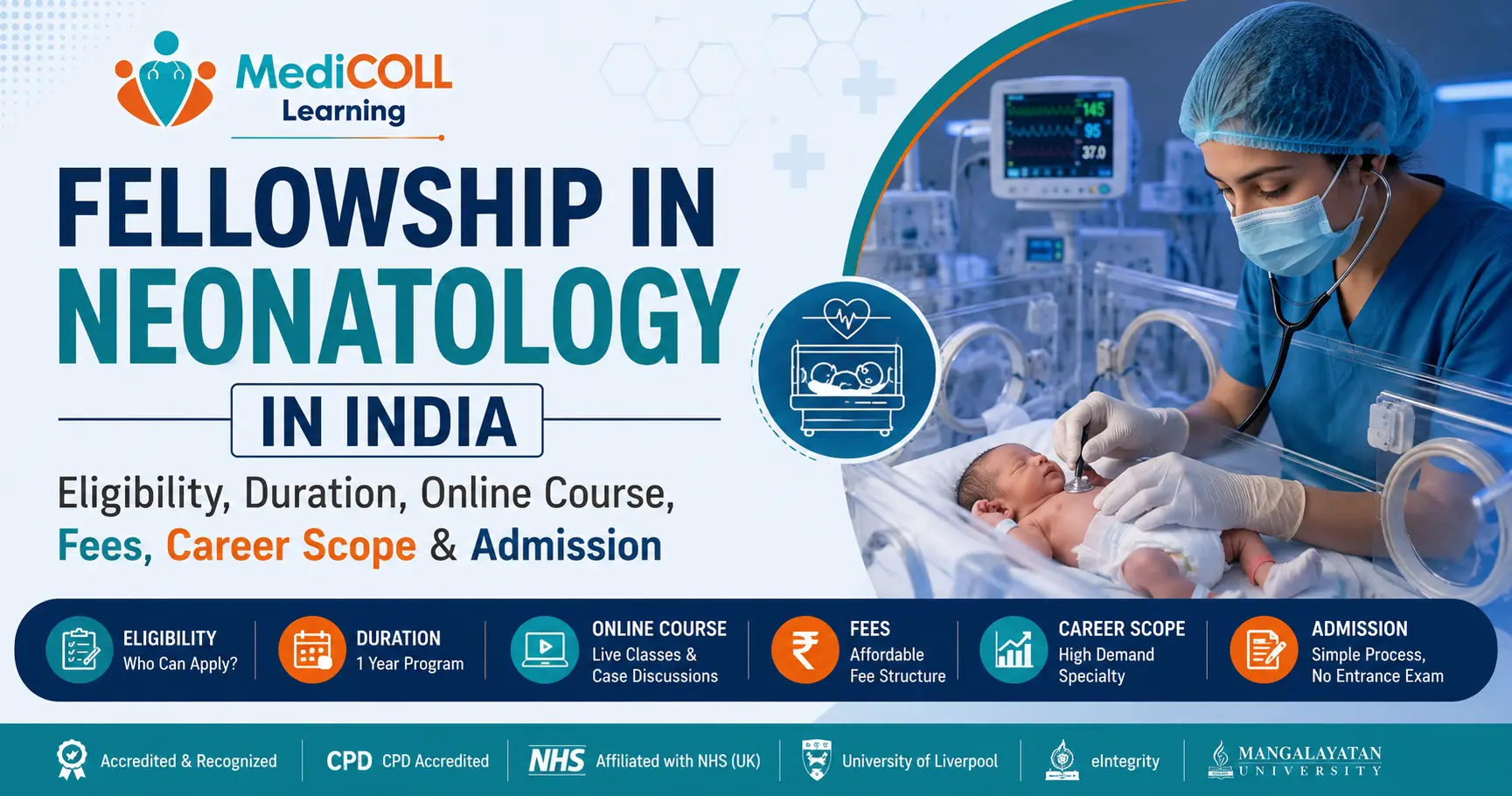
MediCOLL offers a Fellowship in Neonatology Online of one year (12 months) which is a blend of live expert-led sessions including case-based learning along with clinical training. The clinical training takes place in a multi-speciality hospital under the guidance of an experienced neonatologist. This allows doctors to engage with real clinical scenarios rather than just learning theory.
The hybrid structure allows working doctors to continue their existing responsibilities while pursuing the fellowship. The duration of 12 months is divided into two parts. 10 months make up the online phase and the remaining 2 months are dedicated to clinical training.
The curriculum usually spans newborn assessment and resuscitation, respiratory and cardiovascular conditions in neonates, infections and sepsis management, and NICU-specific procedures like intubation and umbilical line placement. It also covers neonatal nutrition, growth and developmental care, metabolic and genetic disorders, and the ethical and psychosocial aspects of NICU work, including palliative care conversations with families.
The Fellowship Course in Neonatology offered by MediCOLL is valid and accredited with national and international bodies like the NHS, eIntegrity, CPD, University of Liverpool and Mangalayatan University. By the end of the fellowship, doctors have covered the full range of conditions they're likely to encounter in a working NICU.
Doctors build competence in performing procedures like neonatal resuscitation and interpreting basic neonatal ultrasound and echocardiography findings. They also develop sharper clinical judgement for managing emergencies. Apart from technical skills, the program builds confidence in family-centred communication, particularly around high-risk births and difficult prognosis conversations.
Most institutes keep the process straightforward for working doctors, application, eligibility check, and enrolment, without requiring an entrance exam. It's worth checking whether the institute offers rolling admissions or fixed intake dates, since that affects how soon you can start.
At MediCOLL, an online application form for the 1 year fellowship in Neonatology is available on the website, which needs to be filled out and submitted. Our admission team will contact upon receiving the submitted form, check the eligibility and explain the next steps. After confirmation, the doctor can enrol in the course by paying the fees in one go or through monthly instalments via financing at no extra interest.
Completing a Fellowship in Neonatology opens up roles in NICUs, children's hospitals, and multi-speciality hospitals with dedicated neonatal units. It also strengthens a doctor's profile for positions in academics and community health programs focused on maternal and newborn health. For doctors already practising paediatrics, it adds a clear specialisation that differentiates their profile in a competitive job market.
Compensation for neonatal care specialists tends to vary significantly based on the hospital's tier, the doctor's prior experience, and whether the role includes on-call NICU responsibilities.
Generally after completing a Fellowship in Neonatology India, starting salary ranges from ₹18 Lakhs to ₹36 Lakhs annually. However, the exact salary depends on experience level, the type of hospital (government or private), and the city where the doctor practices.
Since NICU competence is built through clinical exposure, it is imperative to look for a Fellowship Course in Neonatology with hospital-based clinical training. Also, there is a need to check whether the fellowship is accredited by a recognised body and the curriculum covers technical skills with theoretical knowledge. Another point to keep in mind is faculty experience. Programs led by practising neonatologists tend to offer more clinically grounded teaching than those built around generic paediatric content.
India's neonatal mortality rate remains a public health priority, which keeps demand high for doctors trained specifically in newborn intensive care. The need for doctors who can independently manage emergencies is growing as NICU infrastructure expands across hospitals. Improved survival rates for extremely preterm infants have also increased the complexity of care required. This showcases that demand isn't just about volume, but also about the depth of training too.
NICU doctors deal with high-risk cases regularly, and outcomes aren't always certain. Conversations with families about a baby's condition are part of the job, and they're often difficult ones. The working hours are long with round-the-clock coverage and decisions that sometimes have to be made in seconds during an emergency. On top of that, protocols around ventilation and infection control keep changing, so staying updated isn't optional.
As India's healthcare infrastructure continues to expand into different cities, demand for trained neonatologists is expected to follow. Advances in neonatal ultrasound, functional echocardiography, and less invasive respiratory support are also changing what's expected of a well-trained neonatologist. Doctors who complete structured fellowship training now are positioned to grow into these more advanced, technology-driven roles as the field evolves.
A one year fellowship in Neonatology offers a practical, hospital-grounded route into one of medicine's more demanding but rewarding subspecialties. For doctors drawn to newborn care, particularly the intensity and precision required in NICU settings, it's a structured way to build both the technical skills and the clinical judgement the role requires. Given the pace at which India's neonatal care needs are growing, it's a specialty likely to stay in demand well after 2026.
It is a structured postgraduate training program that equips doctors with advanced skills in diagnosing and managing newborn health conditions especially in NICU settings.
Fellowship in Neonatology duration varies between institutes and is usually one to two years. MediCOLL's fellowship runs for one year and combines online classes with supervised clinical training.
The eligibility includes MBBS, MD/DNB/FNB, medical residents in the hospital, AYUSH practitioners and international medical graduates. However, it is always a good idea to confirm with the institutes before applying.
Yes, provided it's offered by an accredited institute with genuine hospital-based clinical training built into the program, not just online modules.
Yes, a Fellowship in Neonatology after MBBS is one of the more common routes doctors take to specialise in newborn care without committing to a full postgraduate degree.
It can be, particularly for programs offering strong hospital affiliations and hands-on NICU exposure, since seats at reputed clinical training sites are often limited.
Fellowship in Neonatology after BAMS can be a good option and helps to improve confidence in managing newborn cases. However, eligibility check is necessary before enrolling as the eligibility criteria can vary by institutes.
A Fellowship in Neonatology after DCH is an advanced training program designed for doctors who want to build specialized skills in newborn care. The course focuses on managing premature babies, critically ill newborns, neonatal emergencies, and neonatal intensive care (NICU). Through a combination of academic learning and clinical training, doctors gain practical experience in diagnosing and treating a wide range of neonatal conditions. It is a suitable option for DCH-qualified doctors who wish to strengthen their expertise and pursue a career in neonatal medicine.
There is no right or wrong answer for this. The choice totally depends on what a doctor is looking for in the course. The strength of clinical training offered, faculty experience, and accreditation are some factors which one should keep in mind.
The admission process is usually easy as no entrance exam is required for the fellowship. The only pre-requisite is a graduation degree and a recognised medical registration. A 1 year fellowship in Neonatology by MediCOLL offers a simple route to admission. Fill in the enquiry form, and the admission team will connect with you to explain the next steps.
© Copyrights Medicoll All rights reserved.