| Blog Summary |
|---|
| A short-term internal medicine certificate course can help doctors build confidence in managing adult patients. This blog explains what such a programme covers, who can join, and the clinical skills it helps to develop. It also compares the course with an MD, a DNB and a fellowship, and shows how to judge a course before you enrol. If you treat adult patients every day and want a more organised way to approach them, read on. |
Adult patients usually present with multiple comorbidities. Diabetes, hypertension, chronic kidney disease and infection often coexist, and each additional condition changes how the patient is treated. Mostly medical education teaches these health topics by organ system, while clinical practice calls for an integrated approach. To address this gap, doctors are opting for short programmes, such as a certificate course in internal medicine, that help to enhance clinical skills to treat adult patients.
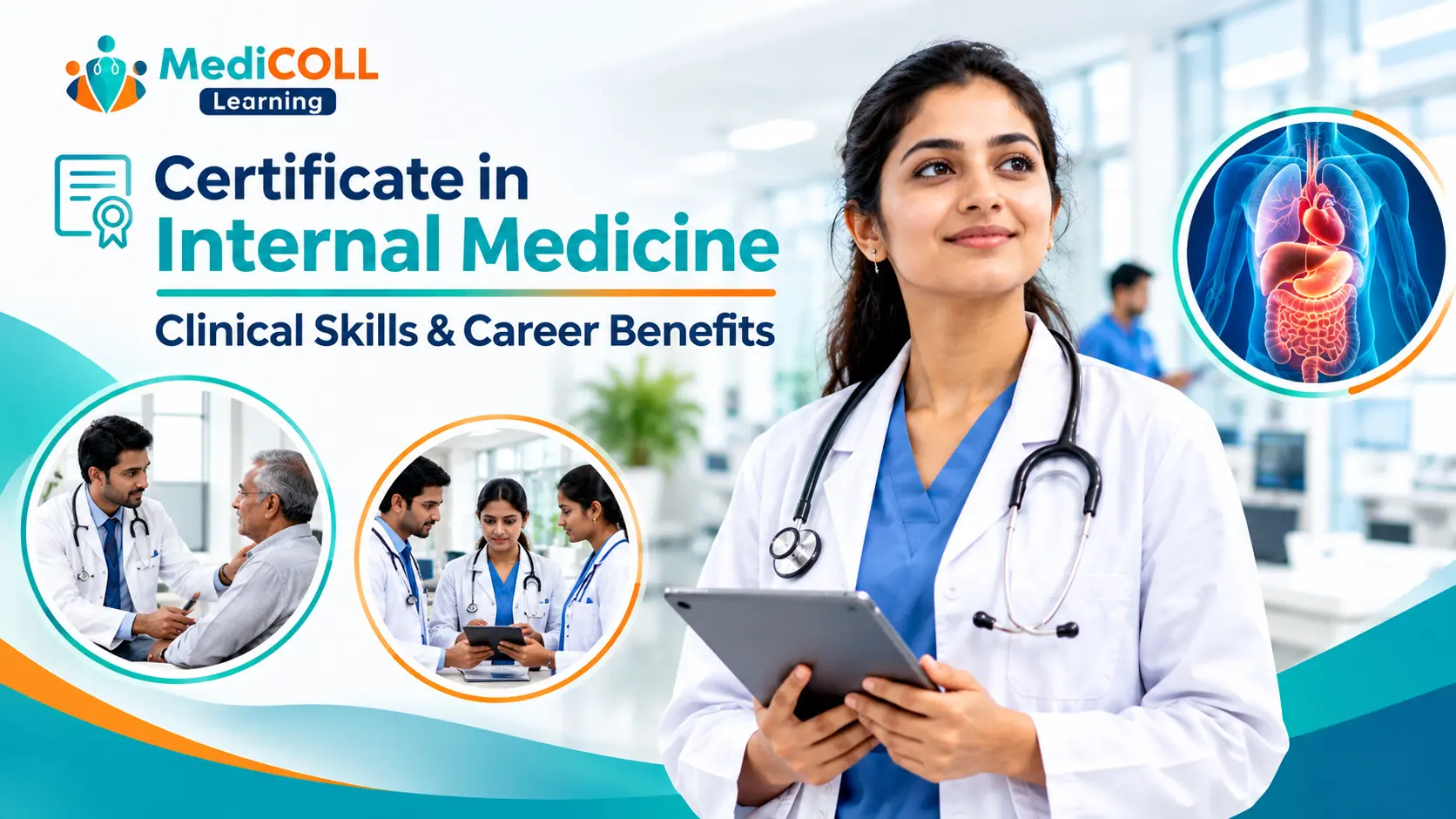
Internal medicine certificate course is a short-term medical training programme designed to build structured knowledge of the diagnosis and management of adult diseases. The syllabus usually covers history taking, examination, investigations, rational prescribing, fluid and electrolyte management, infections and the major organ systems.
The mode of delivery varies between institutes i.e. online or classroom-based. Many courses are now offered online, which lets doctors learn while also managing professional responsibilities. Duration, teaching hours and the assessment method also differ between institutes, so medical professionals should compare these details carefully before they sign up for the course.
Eligibility differs between institutes. The professionals who can usually apply for an internal medicine certification include:
Medical professionals who wish to enrol should read the eligibility section of the course page before applying.
Internal medicine clinical skills are the practical abilities a doctor uses to reach a diagnosis and plan treatment for an adult patient. Most of them come into everyday clinical practice.
An internal medicine course for MBBS doctors helps them revisit the topics covered during graduation and offers focused learning in adult medicine.
According to the WHO fact sheet on noncommunicable diseases, non-communicable diseases caused 75% of non-pandemic deaths worldwide in 2021. ICMR-INDIAB study published in The Lancet Diabetes & Endocrinology in 2023, reported diabetes prevalence of 11.4% and hypertension prevalence of 35.5% in India. These numbers make it quite evident that the doctors in general practice and hospital OPDs meet patients with these conditions generally.
Hence, adult medicine training can help doctors to understand the pattern of these diseases and plan the treatment with more confidence. These conditions require not only immediate treatment but also a long-term plan, which supports better outcomes for patients.
A certificate in internal medicine documents a doctor’s structured training in adult care. Employment and salary growth depend largely on clinical experience, qualifications (graduate or postgraduate), the location of the workplace and the employer.
After completing the certificate, a doctor can look for job opportunities in hospitals, clinics and nursing homes. The certificate also gives a preview of the field of interest, so a doctor can judge whether it is a good fit before committing to a speciality.
A certificate in internal medicine is a skill-enhancement option for doctors, especially working professionals. Many programmes are delivered online, so doctors can learn from anywhere without stepping away from clinical practice, and they offer targeted areas of study. Additionally, they usually do not require an entrance examination to clear.
However, doctors who want a formal postgraduate qualification should plan for an MD or DNB.
The table below compares the main features of a certificate, an MD or DNB, and a fellowship.
| Feature | Certificate | MD / DNB | Fellowship |
|---|---|---|---|
| Description | Short-term medical education programme | Postgraduate specialty qualification | Postgraduate medical training programme |
| Duration | A few months | 3 years | Months to a year |
| Awarding Body | Varies by institute | MD: Universities and institutes recognised by the National Medical Commission (NMC). DNB: National Board of Examinations in Medical Sciences (NBEMS). | Varies by institute |
| Study While Working | Usually possible | Full-time residency | Usually possible |
The choice to select a certificate depends mainly on the doctor’s goals and the time available for study. A doctor with a busy schedule can choose an internal medicine certificate course to build skills within a short time. However, a doctor who wants deeper learning can consider a fellowship. A doctor who wants a formal specialisation post graduate degree in a particular field can go for a qualification, such as an MD or DNB.
After choosing between a certificate and a fellowship, the doctor should check the following points:
MediCOLL Learning is an online platform that provides educational programmes in various medical specialities to healthcare professionals. Its courses are accredited by bodies such as the NHS, eIntegrity, the University of Liverpool and Mangalayatan University. Accreditation from an Indian institution, Mangalayatan University, adds further authenticity to the completion certificate. The courses help doctors upskill and add value to their professional profile.
The internal medicine certificate course offered by MediCOLL Learning builds structured knowledge and clinical skills in a way that mirrors clinical practice. A doctor learns to recognise different disorders, carry out a detailed examination and prepare an effective treatment plan.
The course runs across different modules including conditions like hyponatremia, hyperkalemia and metabolic acidosis; anaphylaxis, asthma and urticaria; tuberculosis, HIV and sepsis; COPD, pneumonia and pulmonary embolism; and acute and chronic kidney disease. The course also covers common ear, nose and throat (ENT) and eye problems, such as sinusitis, diabetic retinopathy and glaucoma.
The programme is designed by experienced internists and is open to medical professionals such as MBBS, MD and AYUSH doctors. No prior experience is required.
The online mode is especially useful for doctors who work in a clinic or hospital and cannot leave for a full-time degree. This includes doctors who cover night shifts or serve small healthcare centres where specialist support is limited.
MediCOLL Learning offers the internal medicine course for MBBS doctors, and for MD, AYUSH or equivalent doctors who want an organised revision of adult medicine. The duration is 6 months, and the fee is ₹70,000, inclusive of all taxes. Doctors who prefer not to pay the full fee amount at once can opt for easy monthly installments (EMI) through a financing partner at no extra cost.
A certificate in internal medicine offers structure learning to the medical professionals and offers a method for managing adult patients who present with several health problems at once. Doctors evaluating internal medicine training should review the curriculum, faculty and recognition for the certificate. The final choice of a certificate rests on the doctor’s current practice and goals.
A certificate in internal medicine is a short-term professional training programme that helps strengthen clinical skills in adult medicine.
Yes. A postgraduate degree is a mandatory requirement to enrol for the certificate. Most programmes ask for an MBBS degree and valid registration, though eligibility differs by institute.
The duration and learning mode of the certificate programme vary between institutes. The certificate offered by MediCOLL Learning is a 6-month online programme.
The internal medicine certification gives a doctor a structured way to revise adult medicine and apply it in daily practice. It builds confidence in assessing common conditions, choosing investigations and planning treatment, and it adds a record of structured training to the doctor’s profile.
MBBS graduates, final-year MBBS students, postgraduates such as MD, DNB or FNB holders, doctors currently in residency, AYUSH doctors and International Medical Graduates (IMGs) are eligible for the internal medicine certificate course.
© Copyrights Medicoll All rights reserved.