| Blog Summary |
|---|
| A fellowship in clinical cardiology is a postgraduate medical training program for medical professionals who want to build focused expertise in cardiovascular medicine. It is designed keeping in mind the hectic schedule of working professionals. The program runs on a hybrid model which combines online live sessions with clinical training in the multispecialty hospital. This blog covers eligibility, how the program is structured, what it costs, and the career paths it opens up in India. |
A fellowship in cardiology is one of the in-demand postgraduate programs in India right now. Cardiovascular disease is the leading cause of death in the country. According to the Indian Heart Association, Indians are at a 3x higher risk of heart disease compared to other ethnicities globally. The cardiovascular specialists are yet not enough in number to meet the growing demand.
A fellowship is a practical choice for the working professionals who wish to upskill without leaving their clinical practice. It covers all the major topics in cardiovascular medicine that would help a doctor to stand out and offer better patient services. This blog covers everything you need to know about pursuing a fellowship in cardiology in India in 2026, including eligibility, structure, fees, and career scope.
A fellowship in clinical cardiology is a postgraduate training program that equips doctors with advanced knowledge and clinical skills in the prevention, diagnosis, and management of cardiovascular conditions. It covers the full spectrum of cardiac medicine including basic electrocardiography, echocardiography, heart failure management, arrhythmias, and interventional cardiology concepts.
In most parts of India, general practitioners and physicians are the first and sometimes only point of cardiac care. A structured fellowship gives these doctors the clinical framework to manage cardiac emergencies, interpret investigations accurately, initiate appropriate treatment, and refer at the right time.
Reputable online fellowship programs are typically accredited by recognised national or international medical educational authorities including NHS approved and MCI approved institutions such as:
Having completed the program successfully, participants receive a certificate of Fellowship in Clinical Cardiology, which lends professional credibility and reinforces clinical competence
Fellowship in clinical cardiology eligibility include:

The curriculum and assessment remain the same for all doctors enrolled into the fellowship. What majorly changes after pursuing fellowship is the starting point and the specific gap the fellowship addresses for each group. Below is how the fellowship in cardiology after MBBS or BAMS or DM helps:
| Qualification | How the Fellowship Helps |
|---|---|
| MBBS |
|
| BAMS |
|
| DM |
|
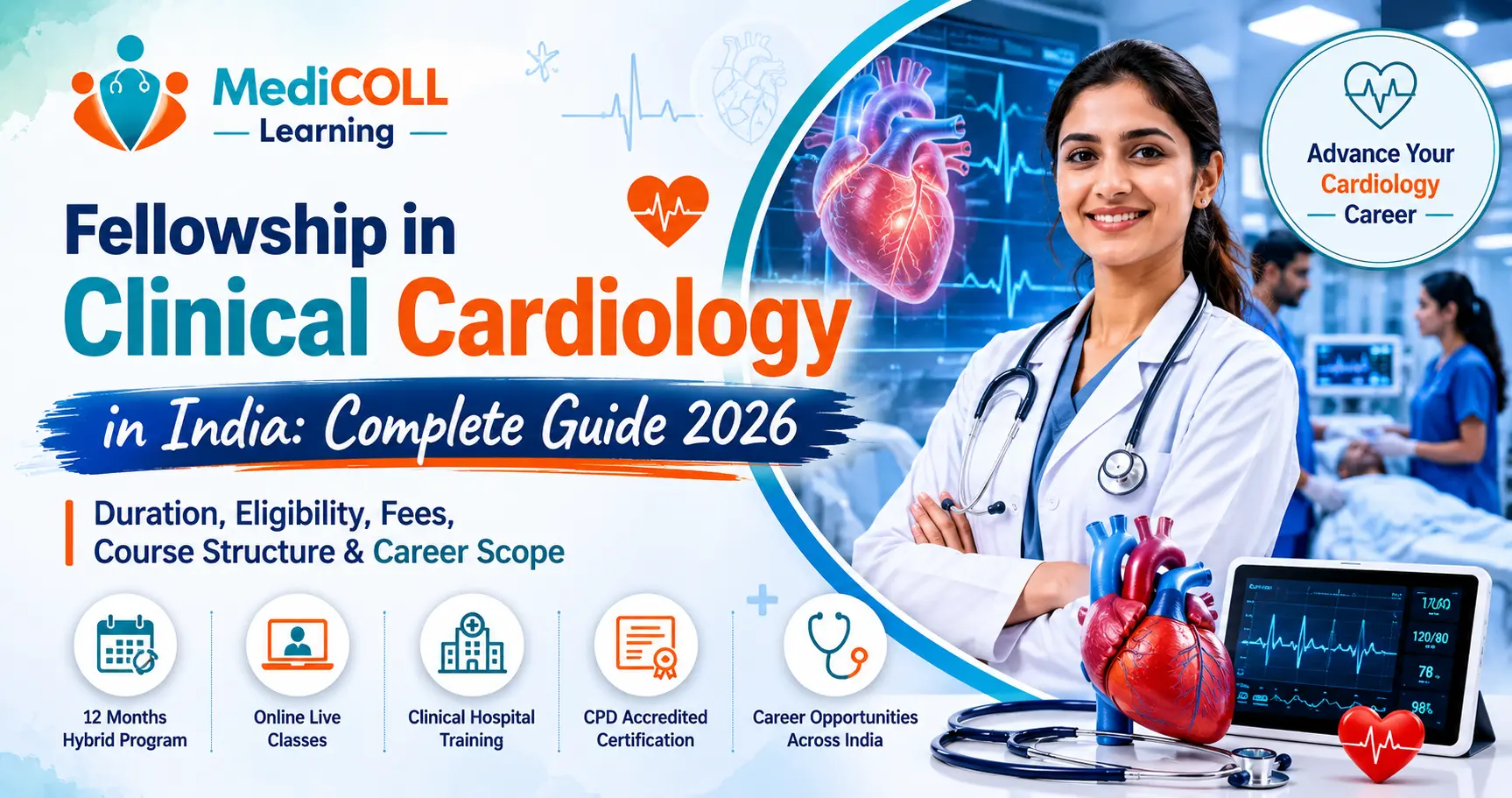
A one year fellowship in clinical cardiology is the most practical format for working doctors. MediColl's fellowship program runs for twelve months. It consists of ten months of online live sessions conducted by experienced cardiologists and cardiac specialists. These are followed by two months of clinical training in a multispecialty hospital under the supervision of cardiac experts.
All the sessions, case discussions, and study material are accessible through the Learning Management System (LMS) portal, which allows doctors to manage their learning schedule alongside their existing clinical responsibilities. The fellowship follows a hybrid structure which means doctors do not have to pause their practice or relocate to complete the program.
The fellowship is affiliated with eminent universities and institutes like the NHS, eIntegrity, the University of Liverpool, and Mangalayatan University. It also carries CPD (Continuing Professional Development) recognition which is relevant for doctors considering opportunities abroad.
The fellowship course in clinical cardiology at MediColl is developed in collaboration with experienced cardiologists and cardiac specialists and organised across different modules.
The curriculum covers major disease areas in detail such as:
Fees of the fellowship can vary depending on the institution, program depth, and format. Short certificate programs of three to six months range from Rs. 20,000 to Rs. 50,000. These certificates provide introductory exposure but often lack the clinical depth needed for independent practice.
Clinical cardiology fellowship programs with live sessions, clinical training, and assessments range from Rs. 1 lakh to Rs. 2 lakhs for the whole term. MediColl's program falls within this fee range. We also offer monthly installment options at no additional interest, payable during the course itself.
A full-time on-campus program is not a realistic option for most practising doctors. Leaving practice for one to two years carries financial and professional costs that are difficult to absorb.
An online fellowship in clinical cardiology solves this directly. The hybrid model of the fellowship combines online learning with clinical exposure so doctors do not have to choose between continuing their practice and building subspecialty skills.
Live sessions are conducted by practising cardiologists and case-based discussions are integrated throughout the curriculum. After completing the online component, the two-month clinical training in a multispecialty hospital ensures that theoretical knowledge translates into practical competency. Fellowship in cardiology online does not mean reduced rigour but access to the same clinical training in a format that works for working professionals.
Completing a fellowship opens up multiple career directions depending on the doctor's existing setup and long-term goals. Some of the career pathways include:
The best fellowship in clinical cardiology in India is one that combines academic rigour, clinical training, and recognised affiliation. All three determine the long-term value of the qualification in practice and MediColl is one of the leading institutes that offer all three to the doctors enrolled in the program.
Yes, a cardiology fellowship can be worth it for doctors who want to strengthen their expertise in cardiovascular care without committing to a lengthy super-specialty pathway. It helps improve clinical confidence, enhances patient management skills, and can open up new career opportunities in hospitals, clinics, and preventive cardiology settings. The value ultimately depends on the quality of training and how it aligns with your career goals.
A Fellowship in Clinical Cardiology is a specialized training program for doctors who want to strengthen their knowledge and clinical skills in diagnosing, treating, and managing cardiovascular diseases. The program typically covers ECG interpretation, heart failure, arrhythmias, hypertension, acute coronary syndromes, and other common cardiac conditions.
The eligibility for a Fellowship in Clinical Cardiology generally includes MBBS graduates, MD/MS/DNB/FNB-qualified doctors, registered AYUSH practitioners, and medical residents. Eligibility criteria may vary depending on the institute, so it is always advisable to check before applying.
Most Fellowship in Clinical Cardiology programs are completed in 12 months. At MediCOLL, the fellowship includes 10 months of online learning with live sessions and case-based discussions, followed by 2 months of supervised clinical training in a hospital.
Yes. MBBS graduates can pursue a Fellowship in Clinical Cardiology to improve their clinical knowledge, develop practical skills in cardiovascular care, and enhance their career opportunities without waiting to pursue a postgraduate degree.
Yes. Many Fellowship in Clinical Cardiology programs do not require NEET PG for admission. These programs are designed to help doctors enhance their clinical skills and gain additional expertise in cardiovascular medicine.
Yes. Many institutes offer online or hybrid fellowship programs that combine online learning with clinical training. Before enrolling, check the course curriculum, faculty, accreditation, certification, and opportunities for hands-on clinical exposure.
Many institutes, including MediCOLL, allow eligible BAMS graduates to enroll in a Fellowship in Clinical Cardiology. The program helps them strengthen their understanding of cardiovascular diseases and patient assessment. Clinical practice should always be carried out within the scope permitted by their professional registration and applicable regulations.
Yes. With the increasing number of cardiovascular diseases in India, there is a growing demand for doctors with advanced knowledge of cardiac care. A Fellowship in Clinical Cardiology can open career opportunities in hospitals, cardiac clinics, preventive cardiology, emergency care, and telemedicine.
The fellowship helps doctors improve their ability to diagnose heart diseases early, interpret cardiac investigations accurately, and manage patients using evidence-based treatment approaches. This leads to better clinical decision-making and improved patient outcomes.
Clinical Cardiology focuses on the diagnosis, treatment, and long-term management of heart diseases using non-surgical methods. The term "General Cardiology" is often used interchangeably, although it may also refer to the broader practice of cardiology without subspecialization.
After completing the fellowship, doctors can work in hospitals, multispecialty clinics, cardiac care centers, preventive cardiology clinics, emergency departments, telemedicine services, and academic institutions. The fellowship also helps strengthen independent clinical practice.
When selecting a fellowship, consider the curriculum, faculty experience, accreditation, learning format, duration, and availability of hands-on clinical training. Choosing a program that combines theoretical learning with practical exposure can help build stronger clinical skills and support long-term career growth.
© Copyrights Medicoll All rights reserved.