| Blog Summary |
|---|
| Nutrition is an integral part of everyday life and plays an important role in health and disease management. A Fellowship in Clinical Nutrition after MBBS helps doctors develop knowledge of dietary modification and nutrition-based care. This blog covers eligibility, curriculum, fees, skills, career scope and professional opportunities while helping MBBS graduates assess whether structured nutrition training fits their clinical practice. |
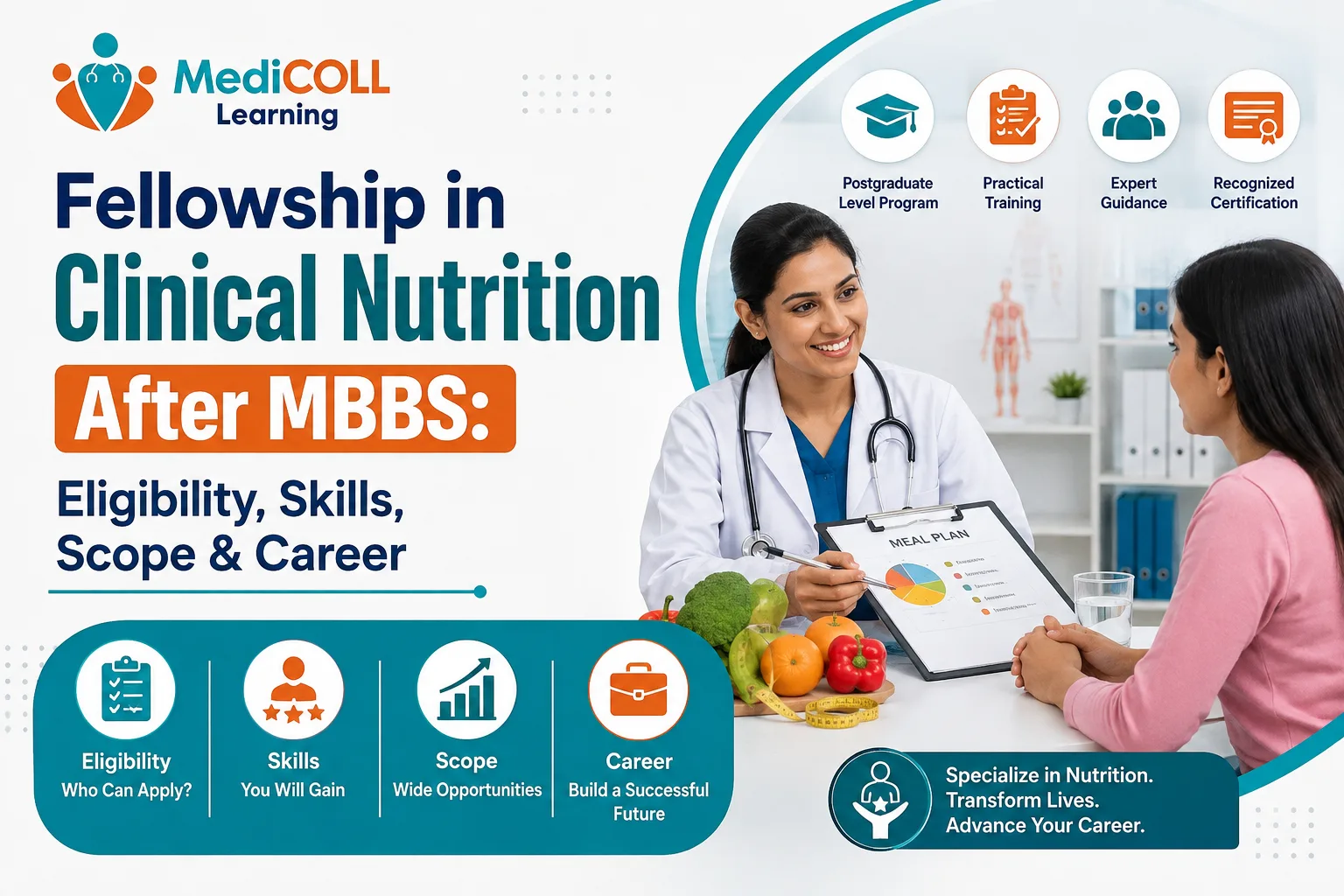
Nutrition has moved from being a peripheral consideration in patient care to something clinicians address routinely. A Fellowship in Clinical Nutrition provides MBBS doctors with structured, applied training in how nutritional status and metabolism influence disease outcomes.
Medical conditions like Diabetes, obesity, and recovery from critical illness all carry a nutritional dimension. A more systematic approach becomes useful for the doctors in cases where dietary management plays a central role in treatment
Clinical nutrition involves assessing a patient's nutritional status, identifying deficiencies or risk factors, and constructing a nutrition plan that supports the broader treatment strategy than functioning as an isolated recommendation. General nutrition addresses eating patterns at a population level.
Clinical nutrition addresses a narrower, more clinical question such as what does this specific patient, with this specific condition, require to recover or remain stable.
A Fellowship in Clinical Nutrition gives doctors a structured framework to learn in depth about nutrition and interpret a patient's nutritional status with the same clinical rigour applied to vitals or laboratory findings.
Fellowships offered by other institutes are typically available in three formats: offline, online, and hybrid. MediCOLL's fellowship and certificate programs follow a combined approach, pairing online classes with clinical training.
These courses are affiliated with established bodies including the NHS, University of Liverpool, eIntegrity, and Mangalayatan University along with CPD-accreditation, which adds a layer of academic and clinical credibility to the certification doctors receive.
Nutrition intersects with nearly every area of clinical medicine, whether the doctor practises general medicine, endocrinology, gastroenterology or critical care.
Patients presenting with lifestyle-related and nutrition-sensitive conditions are encountered across specialties, and many require dietary guidance that extends beyond a brief clinical note.
A Fellowship in Clinical Nutrition After MBBS also strengthens patient communication, since explaining a nutrition plan in a way patients can realistically follow is a distinct clinical skill.&
It adds a layer of training that complements existing specialty for doctors oriented toward preventive care, lifestyle medicine or integrative approaches.
Fellowship in Clinical Nutrition Eligibility varies between institutions and depends mostly on how the curriculum is structured.
The fellowship’s eligibility criteria offered by MediCOLL includes MBBS graduates and B.Sc/M.Sc Food & Nutrition among other healthcare professionals.
Doctors are advised to confirm the specific eligibility criteria of any program before applying, as requirements are not standardised across institutions.

Institutes generally structure the curriculum around nutritional assessment and management across diseases such as diabetes, obesity, cardiovascular disease, therapeutic nutrition and in some programs, nutrition support methods with lifestyle and preventive nutrition.
MediCOLL's Fellowship in Clinical Nutrition is designed by subject experts with the busy schedules of doctors in mind, structured into a detailed, practically oriented curriculum.
It moves from foundational assessment skills into nutrition management across major disease areas, along with focused modules on life-cycle nutrition, surgical and trauma nutrition, and emerging areas like digital nutrition tools.
The curriculum is built to help a doctor develop assessment skills and apply that knowledge in diverse clinical scenarios.
On completing the Fellowship in Clinical Nutrition, doctors are able to conduct a nutritional assessment independently and identify nutritional risk before it develops into a more significant clinical concern.
They gain the ability to interpret nutrition-related clinical data with clarity and use it to inform patient management. Constructing or supporting an individualised nutrition plan becomes part of their clinical repertoire.
Patient counselling on dietary and lifestyle modification also improves as well as doctors develop the judgement to recognise when a case warrants referral to a dietitian or nutrition specialist and when it can be managed within their own scope of practice
An Online Fellowship in Clinical Nutrition in India suits doctors who wish to acquire the expertise without stepping away from practice.
The fellowships offered by MediCOLL include 10 months of online classes followed by 2 months of clinical training in a super-speciality hospital under the supervision of an experienced nutritionist.
Live sessions by nutrition experts, case discussions and study materials are available on the digital platform such as LMS. If a doctor misses a live session for any reason, a recording of the same session is available on the LMS for enrolled doctors.
The hybrid format helps doctors to learn at their own convenience and also there is no need to commute to another place as it is needed in traditional offline programs.
Fellowship in Clinical Nutrition After MBBS in India enables doctors to extend across several clinical and professional settings. Doctors use it in hospitals and clinics, in preventive and lifestyle-focused healthcare, in obesity and weight-management services, and in diabetes or metabolic health clinics.
Corporate wellness programs are increasingly seeking doctors with a working understanding of clinical nutrition. Health education, both patient-facing and public-facing, is another area where this training applies directly, as is telehealth, where doctors are expected to deliver nutrition-informed consultations remotely.
The Fellowship in clinical nutrition in India also contributes to professional growth. It gives doctors a defined area of expertise that can differentiate their practice and strengthens their position within multidisciplinary teams, where nutritional input is increasingly treated as an important part of patient management rather than a peripheral consideration.
It also supports movement into lifestyle medicine, wellness-oriented roles, and healthcare education or content work, where clinical grounding in nutrition carries more weight than general familiarity with the subject.
Fellowship in Clinical Nutrition Fees can differ depending on the institution, program duration, faculty involved, and whether instruction is delivered live or through recorded sessions. Assessment structure, certification and learning resources also factor into overall cost.
The fee for MediCOLL's Fellowship in Clinical Nutrition is ₹1,55,000, inclusive of all taxes. For doctors who prefer not to pay the full amount upfront, a monthly installment option is also available at no extra cost. Additional support from the team is available throughout, so a medical professional's learning journey stays smooth and doctors can upskill without unnecessary hassle.
The best fellowship in clinical nutrition in India for every doctor depends on individual clinical goals and constraints. Before enrolling in any fellowship, it is worth examining a few specific factors closely such as:
Doctors should additionally consider the support systems available during the program and the institution's standing within the medical education space. Weighing a program against the above factors mentioned can give a clearer picture of whether it will meet the actual clinical and professional needs of a doctor.
Nutrition has become a routine component of clinical decision-making across specialties, not a peripheral concern. A Fellowship in Clinical Nutrition offers doctors a way to build in-depth knowledge and skills that help them provide holistic, preventive care to patients through nutrition.
Before selecting a program, doctors should examine curriculum depth, faculty background, eligibility criteria, certification value and delivery format closely. The right fit ultimately depends on how well the training aligns with the clinical situations a doctor is likely to encounter, rather than on institutional reputation alone.
Yes, Nutrition-related conditions are encountered routinely in clinical practice. This Fellowship in Clinical Nutrition After MBBS provides a structured approach to have a deeper understanding of the subject.
All health care professionals interested in clinical nutrition including MBBS graduates, M.Sc /B.sc (food and nutrition) can apply. However, confirming the specific requirements of a given program before applying is advisable.
Yes. Many institutions now offer online or hybrid formats designed around a practising doctor's schedule. The determining factor is whether the curriculum, faculty and certification meet the same standard as an offline program.
It extends across clinical practice, patient counselling, preventive healthcare, corporate wellness and telehealth, adding a defined capability to a doctor's existing role rather than replacing it.
Cost varies by institution, program duration and delivery format. Curriculum depth and learning outcomes are generally a more reliable basis for comparison than fee alone.
© Copyrights Medicoll All rights reserved.