Critical care is one of the most demanding areas in medicine. Patients in the ICU are often unstable, complex, and need round-the-clock monitoring. Managing them well requires focused training, quick decision-making, and a clear understanding of multi-organ dysfunction.
For doctors who are currently working or fresh graduate doctors, the common question arises, what should I do to upskill. While MD/MS is always a great option, it requires long term commitment and managing it can be challenging. Additionally, it also demands a long preparation period. Fellowship in Critical Care becomes a meaningful pathway in such cases.
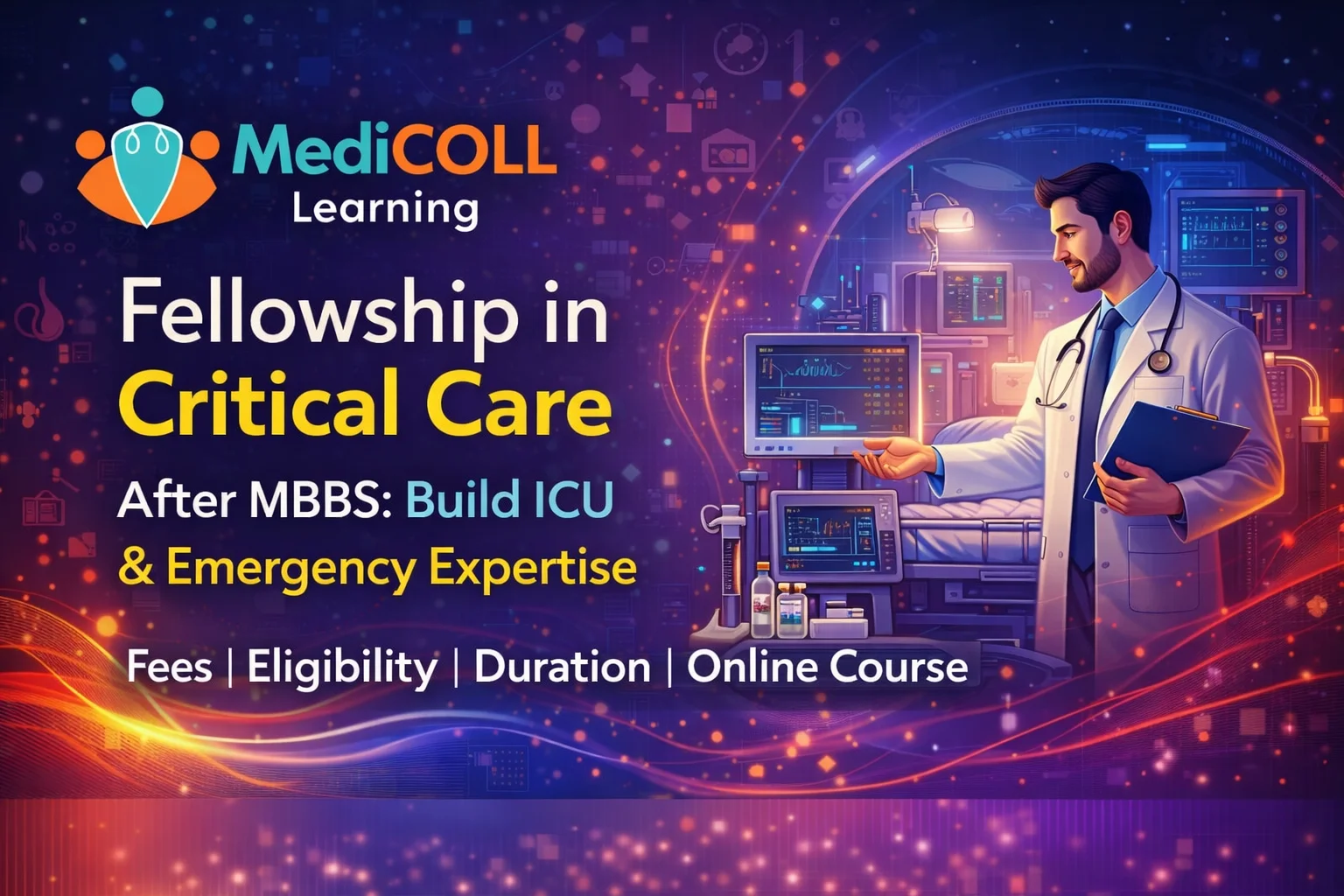
A Fellowship in Critical Care is a structured postgraduate-level training program designed to build clinical knowledge and skills that would help doctors to provide the highest quality of care to the critically ill patients. In India, the demand for trained intensivists has grown significantly over the last decade. Hospitals are expanding their ICU capacities, and there's a growing recognition that ICU outcomes improve when care is led by specialists.
What makes this fellowship different is the depth of clinical exposure and the structured curriculum. It's built for doctors who want to work in ICUs professionally and well equipped to handle critical situations.
MediColl is one of the leading organisations which provide various medical courses to the medical professionals such as Fellowship in Critical Care in India. All the courses are valid and widely recognized with affiliation with eminent institutes and universities such as the NHS, eIntegrity, University of lIverpool and Mangalayatan University.
Along with affiliation with esteem bodies, the fellowship is also recognized under the CPD (Continuous Professional Development).
The fellowships are curated by medical experts and follow a hybrid approach keeping in mind the hectic schedules of the working professionals. The curriculum is created in a way that ensures to coverage of all the essential topics which are relevant for the proper management of the patients in critical care units.
The eligibility for the fellowship includes:
Fellowship in Critical Care Nursing programs have a separate eligibility pathway which requires a B.Sc. or M.Sc. in Nursing with relevant clinical experience in ICU settings. There is no rigid age bar for fellowship programs. However, candidates are expected to have a graduation degree or about to graduate.
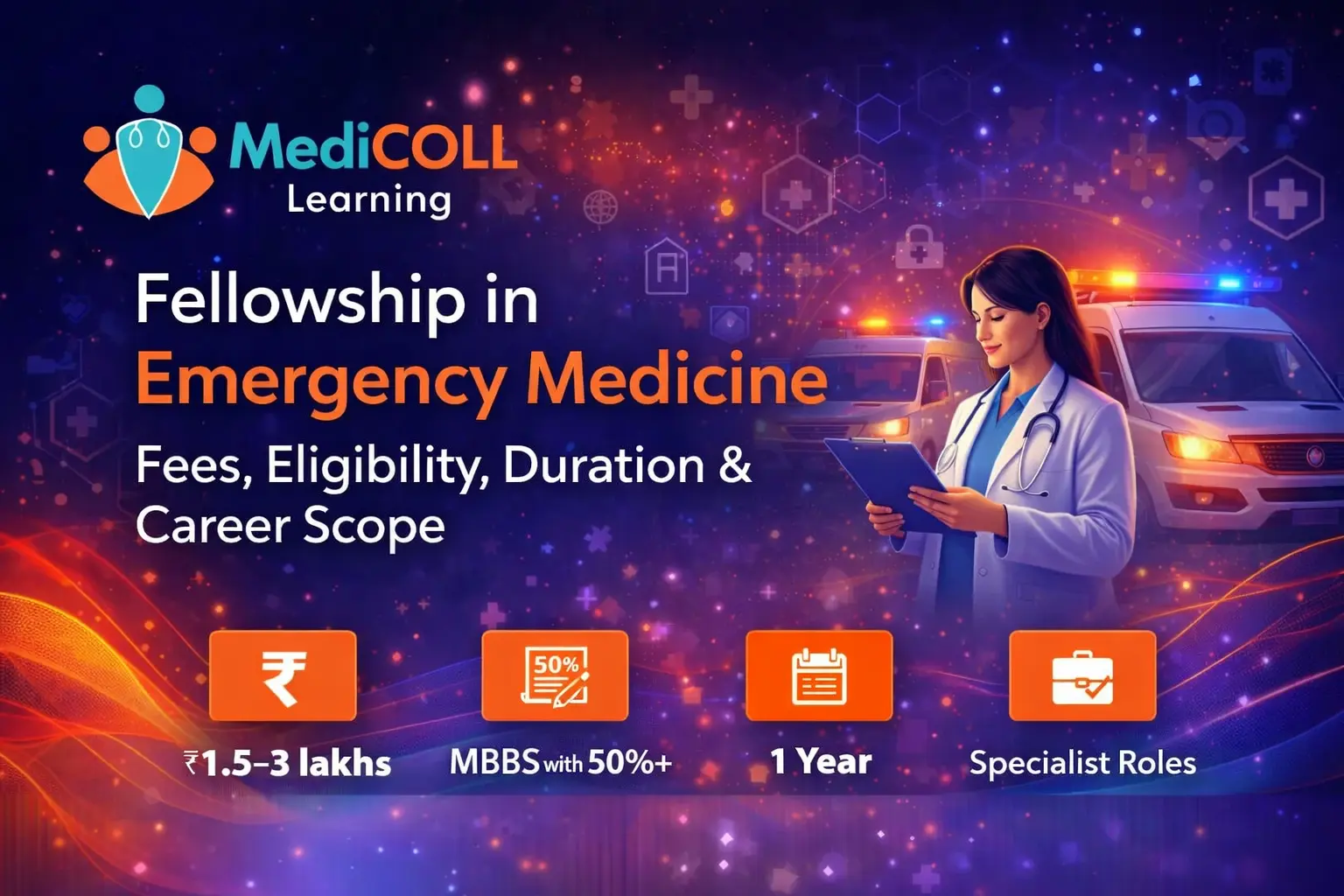
The cost of the fellowship offered by MediColl is ₹1,55,000, inclusive of all taxes. For those who prefer not to pay upfront, a monthly installment option is also available through financing at no additional interest.
One of the most common questions fresh MBBS graduates ask is whether they can pursue a fellowship in critical care without a postgraduate degree. The answer is yes. A Fellowship in Critical Care after MBBS is a valid and increasingly rising route to upskill. The fellowship gives doctors a focused, time-efficient way to build clinical expertise in medicine.
Fellowship in Critical Care Medicine in India after MBBS by MediColl is structured keeping in mind the doctors who are already working or wish to upskill. The curriculum is designed by medical experts and builds foundational ICU competencies from starting with patient assessment, basic life support protocols, and ICU workflows, then gradually moving into advanced topics like ventilator management, vasopressor use, and multi-organ failure
The admission process of online Critical Care fellowship involves simple steps and is designed to be accessible.
Steps involved are:
1. Application Submission - Interested medical professionals fill out an online enquiry form available on the official website of MediColl with basic personal details like name and phone number, along with mentioning the fellowship of interest.
2. Screening Assessment - After the application form is received, the admission team connects with the applicant to discuss further.
3. Eligibility Check - Once eligibility is confirmed, the next step is initiated. Submission of certain documents is required, including identity proof, educational degrees, and payment details.
4. Fee Payment & Enrollment - Once payment is done, enrollment is confirmed. The applicant will receive access to the online learning portal and class schedule details.
The admission team usually responds to queries within 24 hours. The entire process from application to enrollment takes up to one week
The duration for a Fellowship in Critical Care Medicine Online is one year (12 months). The fellowship includes theory which is for 10 months followed by 2 months of clinical training in a multispecialty hospital.
The theoretical classes are delivered online through recorded lectures, live sessions, case discussions, and modules. Sessions are led by the experienced critical care specialist and scheduled on weekends to reduce conflict with clinical duties. Clinical training in an ICU setting gives exposure to the pursuing doctors towards the real patients.
The online approach of the fellowship makes clinical knowledge more accessible. Doctors in smaller cities, those in active practice, or those with family commitments can now pursue this fellowship without relocating or taking a career break.
The curriculum of this one year critical care certificate course covers the full breadth of what a doctor needs to function confidently in an ICU. Below are the major topics covered across the program:
Completing this Fellowship in Critical Care Medicine Online program builds a skill set that is directly applicable on the ICU floor. Some of the acquired skills would be:
India's ICU infrastructure has expanded significantly over the last decade. Corporate hospital chains, standalone ICU units, and government tertiary care centres are all scaling up and the demand for trained intensivists continues to outpace supply. A fellowship-trained doctor is well-positioned to step into critical care medicine.
The career opportunities after a Fellowship in Critical Care in India includes working in Private and government hospitals as ICU medical officers, junior intensivists, or critical care consultants depending on experience and further qualifications
Doctors can also find working opportunities in Trauma and emergency centres, Obstetric and maternity ICUs, Tele-ICU and remote critical care, Air ambulance and retrieval medicine. Those interested in academic, research or public health careers can explore the working options with organizations and medical colleges.
Salary expectations depend on certain factors and can vary by city, hospital type, and clinical experience level. Post-MBBS fellowship graduates typically start between ₹60,000 to ₹1,00,000 per month in private setups. Doctors with additional PG qualifications and fellowship certification can command significantly higher packages in senior intensivist roles.
The fellowship also serves as a strong foundation before pursuing DNB Critical Care, MD Pulmonology, or other postgraduate pathways. The clinical exposure and structured knowledge make the transition into those programs considerably smoother.
This Fellowship in Critical Care is designed for anyone who works in or around critically ill patients and wants structured, credible training to back their clinical experience.
It includes:
Pursuing a Fellowship in Critical Care Online offers numerous advantages, Some of them are:
Structured knowledge in a high-demand specialty - Critical care is one of the fastest-growing medical fields in India, and trained intensivists remain in short supply relative to the expanding ICU infrastructure
The decisions made in an ICU in the first few hours often determine whether a patient survives. That kind of responsibility needs focused, structured preparation. A Fellowship in Critical Care after MBBS offers an excellent pathway for the medical professionals who wish to enhance their knowledge and skills in critical care medicine. The online format of the fellowship makes it accessible without taking away from the depth of training. It is a practical, credible step toward becoming a more confident and capable clinician in critical care.
© Copyrights Medicoll All rights reserved.