| Summary |
|---|
| Fellowship in Emergency Medicine is a practical and career-focused program for doctors who want to build confidence in managing critical, trauma, and time-sensitive medical emergencies. The fellowship combines structured learning with real-world clinical exposure, making it suitable for MBBS graduates, practicing doctors, and postgraduates. With flexible hybrid learning, doctors can strengthen emergency care skills, improve clinical decision-making, and expand career opportunities in hospitals, ICUs, trauma centers, and emergency departments across India. |
Fellowship in Emergency Medicine is becoming an important career option for doctors who want to build strong clinical skills in managing critical and time-sensitive situations. In emergency settings, doctors are required to make quick decisions, prioritize patients, and stabilize conditions within minutes.
Even experienced doctors can feel uncertain in high-pressure environments without structured training. A well-designed emergency medicine program helps improve confidence, clinical judgment, and practical skills required in real-life emergency cases.
For many doctors in India, the challenge is finding a program that fits alongside their clinical responsibilities. This is where flexible and hybrid learning models make emergency medicine training more accessible without requiring a career break.
A Fellowship in Emergency Medicine is a postgraduate-level training program designed to help doctors manage emergency and critical care situations effectively. Compared to traditional degree programs, it is shorter in duration and focuses on practical, real-world clinical exposure.
The course typically covers:
This structured approach helps doctors handle a wide range of emergency cases in hospitals and clinical settings.?
| Feature | Details |
|---|---|
| Program Name | Fellowship in Emergency Medicine |
| Program Level | Postgraduate Fellowship |
| Duration | 12 Months |
| Learning Mode | Online live classes + clinical training at a multispecialty hospital |
| Eligibility | MBBS / MD / FNB / DNB / Medical Residents / Final-year MBBS students / AYUSH practitioners |
Credible online fellowship programs are often backed by recognised national or international medical educational authorities, such as:
On successful completion of the program, participants receive a certificate of Fellowship in Emergency Medicine, which boosts professional credibility and deepens clinical expertise.
MediCOLL's fellowship programs are curated in accordance with NHS approved and MCI approved standards of medical education
A one-year program offers enough time to build strong clinical understanding without long-term academic commitment.
Key reasons include:
Short-term courses often lack depth, while longer programs require full-time commitment. A one-year fellowship strikes the right balance.
Fellowship in Emergency Medicine Eligibility includes:

One of the most common concerns among fresh MBBS graduates is what to do next. MD or MS is the obvious route, but it is also competitive, expensive, and not always immediately accessible.
During preparing for entrance exams period or for those doctors who decided that MD is not the immediate plan, a fellowship gives doctors something meaningful to do with that time. Fellowship can be a meaningful choice that builds clinical value for the doctors and act as a base for future learning plans.
Doctors who have recently completed MBBS and are already working in clinics, hospitals, or rural health centers, Fellowship in Emergency Medicine after MBBS is a valuable option.
Doctors who plan to pursue MD in Emergency Medicine eventually, meanwhile completing a fellowship first can be a great tool for practical exposure to the field. This helps to decide if it is the right specialization and adds substance to the professional profile.
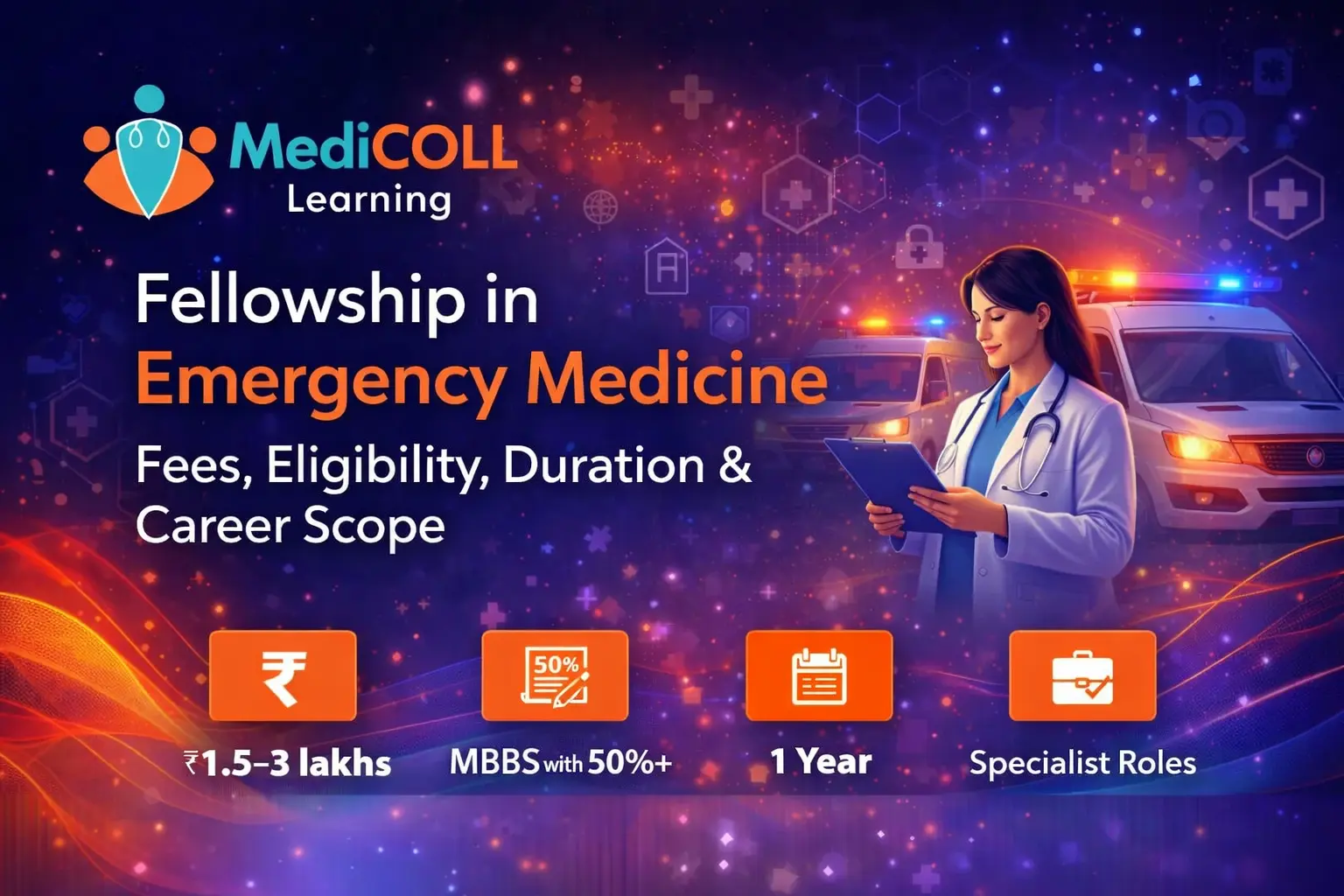
The fee for MediCOLL's Fellowship in Emergency Medicine is listed as ₹1,55,000 on its course page. Applicants should confirm the latest fee, payment schedule, applicable taxes, financing terms and any additional expenses related to clinical training before enrolment.
Fees for other emergency medicine programmes can differ considerably because they may offer different qualifications, durations, admission pathways and levels of hospital-based training. Compare programmes on a like-for-like basis rather than assuming that every fellowship or postgraduate course provides the same training or qualification.
When evaluating a programme, consider the curriculum, faculty expertise, clinical exposure, assessment methods, certificate-awarding body and documented recognition alongside the total cost.
Clinical training is an important consideration when choosing a Fellowship in Emergency Medicine. It helps learners understand how emergency departments assess and prioritise patients with acute illnesses, injuries and potentially life-threatening conditions.
MediCOLL describes its fellowship as a hybrid programme with online academic learning and a clinical training component. Prospective applicants should confirm the duration of hospital training, the placement location, supervision arrangements, attendance requirements and the clinical activities available during the programme.
The curriculum may address emergency assessment, triage, trauma management, cardiac and respiratory emergencies, neurological emergencies and initial patient stabilisation. The actual procedures learners can observe or perform depend on the training site, their existing qualifications, supervision and institutional protocols.
Before enrolling, applicants should request written details of the clinical component and clarify whether the placement includes supervised practical experience, observership or a combination of these activities.
The Emergency Medicine fellowship provides comprehensive training in the assessment, diagnosis, and management of medical emergencies. The programme combines evidence-based learning with practical clinical exposure, helping doctors develop the skills required to manage critically ill patients, trauma cases, and emergency situations in hospitals and acute care settings.
The table below discusses the detailed programme outline for the Fellowship in Emergency Medicine:
| Category | Programme Details |
|---|---|
| Introduction to Emergency Medicine | Fundamentals of emergency care, triage systems, patient assessment, and emergency department workflow |
| Emergency Patient Evaluation and Triage | Rapid assessment, prioritization of care, and stabilization of critically ill patients |
| Airway Management and Resuscitation | Basic and advanced airway management, CPR, advanced life support, and emergency resuscitation techniques |
| Trauma and Critical Care Emergencies | Management of trauma, burns, fractures, head injuries, and life-threatening emergencies |
| Cardiovascular Emergencies | Diagnosis and treatment of cardiac arrest, acute coronary syndrome, arrhythmias, and shock |
| Respiratory Emergencies | Management of asthma, COPD exacerbations, respiratory failure, and oxygen therapy |
| Neurological Emergencies | Emergency care for stroke, seizures, altered consciousness, and traumatic brain injuries |
| Pediatric and Obstetric Emergencies | Assessment and management of pediatric emergencies and obstetric complications |
| Toxicology and Poison Management | Recognition and treatment of poisoning, drug overdose, and toxic exposures |
| Disaster Medicine and Mass Casualty Management | Emergency preparedness, disaster response, mass casualty triage, and crisis management |
Fellowship also opens additional doors for doctors who are interested in working or studying abroad. After completing a 1 year Fellowship in Emergency Medicine, doctors can work across diverse clinical settings such as:
The salary of an emergency medicine physician in India depends on factors such as existing medical qualifications, clinical experience, employer, location, responsibilities and the nature of the role. Doctors working in different hospitals or emergency care settings may receive different compensation.
Salary estimates published by recruitment and employment platforms can provide a general reference, but they are based on specific datasets and may not represent every doctor or region. For example, Indeed reported an average base salary of ₹1,20,717 per month for Emergency Medicine Physicians in India in December 2025, based on nine reported salaries.
Completing a fellowship does not guarantee a salary increase, promotion or a particular job. Its professional relevance depends on the training provided, the doctor's existing qualifications, employer requirements and applicable regulations. Applicants should assess the programme primarily on its educational value, clinical training and suitability for their career goals.
This fellowship is relevant for all medical professionals. Any doctor who deals with or expects to deal with emergency presentations in their practice should consider this program.
Others who should consider Fellowship in Emergency Medicine in India are:
The benefits of pursuing a Fellowship in Emergency Medicine after MBBS are:
Overall, the fellowship offers a high return on investment both professionally and in terms of patient care quality.
With several Emergency Medicine Fellowship Programs available, choosing the right one requires careful thought.
One year Fellowship in Emergency Medicine gives doctors the tools to handle high-pressure situations more effectively without requiring stepping away from their current roles. This fellowship offers focused, practical, and flexible learning. It is a worthwhile step for professional growth as well as helps to provide best quality of care to patients who walk into an emergency needing immediate, competent help.
A Fellowship in Emergency Medicine is a postgraduate medical program curated for medical professionals. The fellowship helps medical professionals gain expertise in emergency medicine and act promptly in urgent situations.
Yes, eligible working doctors can pursue a 1-year Fellowship in Emergency Medicine if the programme's schedule and clinical training requirements fit their professional commitments. MediCOLL Learning offers a 12-month hybrid programme that combines online academic learning with hospital-based clinical training. Before enrolling, doctors should confirm the attendance requirements, clinical training schedule, eligibility criteria, fees, and certification details.
The best Fellowship in Emergency Medicine depends on a doctor's qualifications, clinical interests, and training requirements. When comparing programmes in India, consider the curriculum, faculty experience, hospital-based clinical training, assessment methods, fees, and certificate-awarding institution. MediCOLL Learning offers a 12-month Fellowship in Emergency Medicine combining online
Yes, one-year Fellowship in Emergency Medicine programs are available in India. MediCOLL Learning offers a 12-month program that combines online academic learning with hospital-based clinical training. The program covers emergency assessment, triage, trauma, cardiac and respiratory emergencies, and other time-sensitive conditions. Before enrolling, doctors should review the eligibility criteria, curriculum, clinical training arrangements, fees, and certification details.
The eligibility to apply for the fellowship varies from institute to institute. Usually, a graduation degree and valid medical registration are enough to enroll in the fellowship.
The fees for the Fellowship range from ₹80,950 for government institutes up to ₹20,00,000+ for premium clinical fellowships. MediColl offers this fellowship at ₹1,55,000/- inclusive of all taxes. If you prefer not to pay the full amount upfront, you can pay in monthly installments through financing at no additional interest.
The Fellowship in Emergency Medicine is usually a one-year program designed with a hybrid learning approach. It includes online academic sessions, recorded lectures, and case discussions, followed by clinical training in a hospital setting. This structure allows doctors to learn theoretical concepts while also gaining real-world exposure to emergency patient care.
Yes. MBBS graduates are eligible to enroll in the fellowship. It is a practical option for fresh graduates who want to build clinical skills in emergency medicine before committing to a longer postgraduate program.
Yes, Emergency Medicine (EM) has various fellowship opportunities. Physicians can pursue subspecialty paths such as critical care and pediatric emergency medicine. Fellowships generally take 1 to 2 years to complete and enable doctors to build specialised skills in their chosen field of specialty.
Yes, the Fellowship in Emergency Medicine Online is affiliated with reputed universities like the NHS. The CPD accreditation is an added advantage for doctors who are looking at career opportunities abroad or simply want to show consistent professional growth over time.
A Fellowship in Emergency Medicine equips medical professionals with skills in rapid patient assessment, triage, and critical decision-making under pressure. Participants also gain clinical expertise in managing trauma, cardiac emergencies, and other life-threatening conditions. Upon completion, medical professionals are proficient in emergency procedures and protocols.
The most practical difference is time and flexibility. A fellowship is shorter and does not need an entrance exam, so working doctors can enroll without much disruption. A diploma takes longer and usually needs full-time commitment which is a bit challenging, especially those already managing a clinical workload.
MBBS graduates, postgraduate doctors, and practicing clinicians can apply for a Fellowship in Emergency Medicine. It is suitable for both fresh graduates and experienced doctors who want to strengthen their ability to manage emergency cases. Even those working in clinics or hospitals can join to gain structured training in handling critical and time-sensitive situations.
International students who wish to pursue the Fellowship in Emergency Medicine can apply for the program. The only eligibility is the medical professional should have a graduation degree such as MBBS.
© Copyrights Medicoll All rights reserved.