| Blog Summary |
|---|
| A rash is a change in the colour, texture or feel of the skin, usually triggered by allergy, irritation, infection or an immune problem. Most rashes settle on their own or with basic home care, but some may require urgent medical attention. This blog covers how rashes are identified, their common causes and types, how symptoms help with diagnosis, treatment options, reasons some rashes do not improve, warning signs and prevention. |
Skin rashes are changes in the colour, texture or feel of the skin, usually caused by allergy, irritation, infection or an underlying condition. Most settle with simple care but some need prompt medical attention.
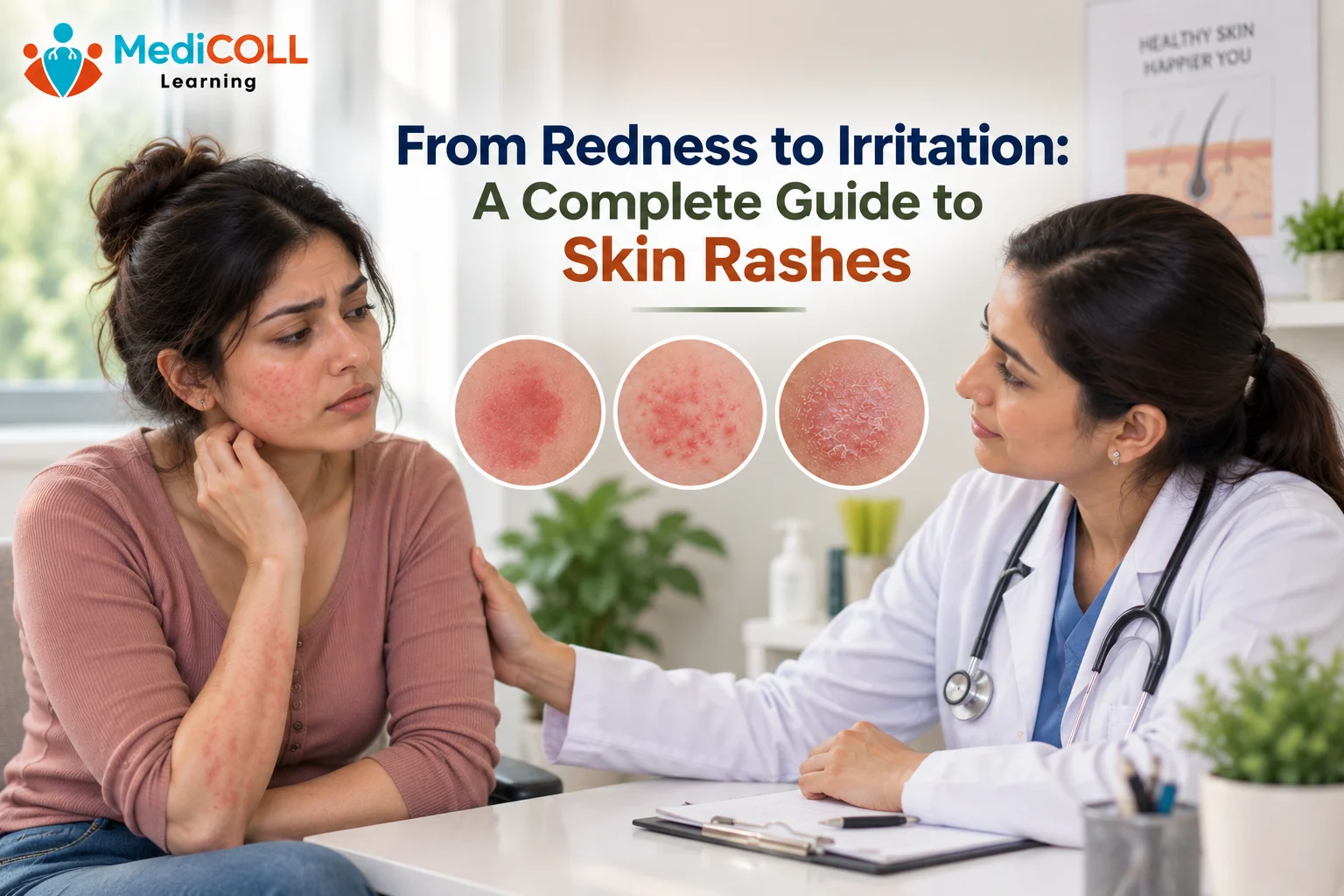
A rash can be red, bumpy, dry, scaly or blistered, and it may itch, sting or hurt. Distinguishing one rash from another is harder than it sounds, since skin redness and irritation look alike in many different conditions.
A rash is an area of skin that looks or feels different from the skin around it. Doctors identify it by its appearance, where it sits and how long it has been there.
The first thing a doctor assesses is the type of lesion, that is, whether it is flat, raised, fluid-filled or pus-filled, followed by the pattern of the lesion. A rash confined to the hands, arranged in a ring, or running in a band along one side of the body says more than its colour does.
Even a plain red rash on skin that looks minor should be examined by a doctor, as the same redness can come from very different causes. The timing of onset is another factor to consider. A rash that appears within hours may be hives or a drug reaction, while one that has lasted for months is more likely to be eczema, psoriasis or a fungal infection.
A rash is a clinical sign that points towards a cause, and it does not amount to a diagnosis by itself. The trigger may come from outside the body, from an infection, or from the immune system.
Most cases trace back to dermatitis, in which the skin becomes inflamed after an allergen sensitises it or an irritant damages it. Skin rash causes fall into several groups. Contact triggers such as soaps, detergents, nickel jewellery, fragrances and plants leave a rash where they come in contact with the skin.
Infections, including viral rashes, ringworm, impetigo and scabies, often come with fever, a ring-shaped patch, or several people at home affected. Immune-related conditions like eczema, psoriasis and hives tend to keep coming back and eczema and psoriasis often run in families.
Medicines, especially antibiotics, analgesics such as NSAIDs and anti-seizure drugs, can cause a rash days to weeks after the first dose. Heat, sun and illnesses like lupus, viral hepatitis and Kawasaki disease can also cause rashes.
Some causes of skin irritation are easy to miss such as a new hand sanitiser, a different detergent or a fragrance in a body lotion, all of which can set off a rash, yet people rarely suspect them.

A few rash types account for most clinic visits. Eczema, contact dermatitis, hives, psoriasis, fungal infections and viral rashes lead the list.
Studies report that 6% to 24% of primary care visits are linked to skin conditions, so rashes are a daily part of a doctor's work. In children, eczema, impetigo, ringworm, scabies and chickenpox are among the ones seen most often. The table below covers some of the common types of skin rashes seen in clinical practice.
| Rash | What it looks like | Where it usually appears |
|---|---|---|
| Eczema | Dry, red, scaly, very itchy patches | Skin folds, hands, face in young children |
| Contact dermatitis | Red, itchy, sharply outlined patches | Where the trigger touched |
| Hives | Raised welts, each fading within 24 hours | Anywhere |
| Psoriasis | Thick, silvery, scaly plaques | Elbows, knees, scalp, lower back |
| Ringworm | Ring with a clearer centre and scaly edge | Body, groin, feet, scalp |
| Viral rash | Widespread red spots with fever | Trunk, then arms and legs |
| Heat rash | Tiny red bumps in sweaty areas | Neck, skin folds, back |
An itchy skin rash in an otherwise healthy adult is commonly eczema, contact dermatitis or hives, though fungal infections and scabies should stay on the list
Symptoms show how the skin is reacting and how deep the problem may be. Itching, pain, burning and fever each point in a different direction.
Both the patient history and a physical examination are essential when assessing a rash. Questions a doctor should ask include:
Itching suggests eczema, hives, scabies or a fungal infection, while burning or pain points more towards shingles or a drug reaction. Skin rash symptoms can come with other features. Fever, joint pain, mouth ulcers or breathlessness alongside the rash suggest that a systemic condition is involved. A note of new soaps, cosmetics, plants, pets or medicines in the last month often points to the cause.
Skin pigmentation also influences how a rash presents. On darker skin, a rash can show up as pale grey patches or deeper brown and black shades rather than red, so a doctor should check for warmth, swelling and texture by touch. Otherwise, common skin rashes get mistaken for something milder and are treated too lightly.
Read Also: Pimples on the Face: Causes, Home Remedies and Medical Treatment
Treatment is guided by the underlying cause rather than by the degree of redness. In most cases, removing the trigger and repairing the skin barrier can help before any strong medicine is needed.
The first step is to remove the cause of the rash, if it can be found. Measures such as changing the soap, stopping the new cream, or asking the doctor to review any new medicine can be beneficial. A fragrance-free moisturiser, used often, is the base of skin rash treatment for eczema and most dry, irritated skin.
For mild inflammation, low-potency steroid cream such as 1% hydrocortisone can soothe many rashes. On the face, in skin folds and in children, it should be used only when advised by a doctor.
Once the cause is clear, treatment becomes specific such as an antifungal for ringworm, an antibiotic for impetigo, permethrin for scabies. Antibiotics do not help most rashes, so they are used only when the cause is a bacterial infection. An antihistamine tablet can help with an itchy skin rash. Some antihistamines, such as chlorpheniramine, can cause drowsiness, while newer antihistamines such as cetirizine are generally less sedating.
When a rash does not respond, the usual reason is a wrong diagnosis or a trigger that is still present. Steroid creams are a common part of the problem.
A ring-shaped fungal rash is the classic example. A steroid cream can calm the redness for a few days, which makes it look as if the treatment is working, but the fungus keeps spreading and the rash changes shape. This condition is called tinea incognito. A skin scraping examined with potassium hydroxide (KOH) can help confirm a fungal infection and it is worth doing before any steroid is started on an unclear ring.
The second common reason is a hidden trigger. If a rash keeps recurring, factors like the soap, detergent or nickel jewellery may still be part of the daily routine. Patch testing can help find the causative agent.
A red flag rash points to a serious underlying condition that may affect other organs as well. Most skin rashes are harmless, but some features change the picture. Signs that need immediate attention include:
A child with a rash who also has a stiff neck, seems confused, or looks pale, blue or grey needs emergency care at the nearest hospital.
A new rash after starting a medicine should be taken seriously. A doctor should be contacted early, and long-term medicines should not be stopped without a doctor's advice. A red rash on skin that blisters or hurts is different from a rash that only itches.
Read Also: MD vs DNB Dermatology: Differences, Salary & Career Scope
Prevention means avoiding the trigger and protecting the skin barrier.
Most skin rashes are harmless and settle with simple care, but the cause is not always clear from the colour alone. A careful history, a close look at the lesion and a gentle approach to treatment solve most cases. A rash that spreads, blisters, hurts, comes with fever or keeps returning needs a proper review by a doctor.
Doctors who wish to build in-depth clinical knowledge and skills in dermatology can also explore alternative learning options like fellowships apart from post graduate degree. MediCOLL Learning is an online platform offering fellowship and certificate programs for medical professionals.
Many skin rashes fade away on their own, especially viral rashes, heat rash and mild irritation from a new soap. However, if the rash spreads, blisters or keeps returning, it is best to see a doctor.
An allergic rash follows the area that touched the trigger. A fungal rash often forms a ring with a scaly edge and a clearer centre.
No. There is no single skin rash treatment that suits every rash. Steroid creams, for instance, can hide ringworm, so the cause should be confirmed first.
A dermatologist should be seen if the cause stays unclear after a first review, or if the rash is widespread, long-lasting or keeps recurring.
© Copyrights Medicoll All rights reserved.