| Blog Summary |
|---|
| A robotic and laparoscopic urology fellowship after MS General Surgery helps surgeons develop advanced skills in minimally invasive urology without pursuing a full super-specialty degree. This guide explains eligibility, fellowship curriculum, training duration, and why urology continues to be one of the highest-paying surgical specialties in India. |
A robotic and laparoscopic urology fellowship after MS General Surgery trains general surgeons in minimally invasive urology techniques, including robotic-assisted procedures, without requiring a full super specialty degree like MCh or DNB in Urology first.
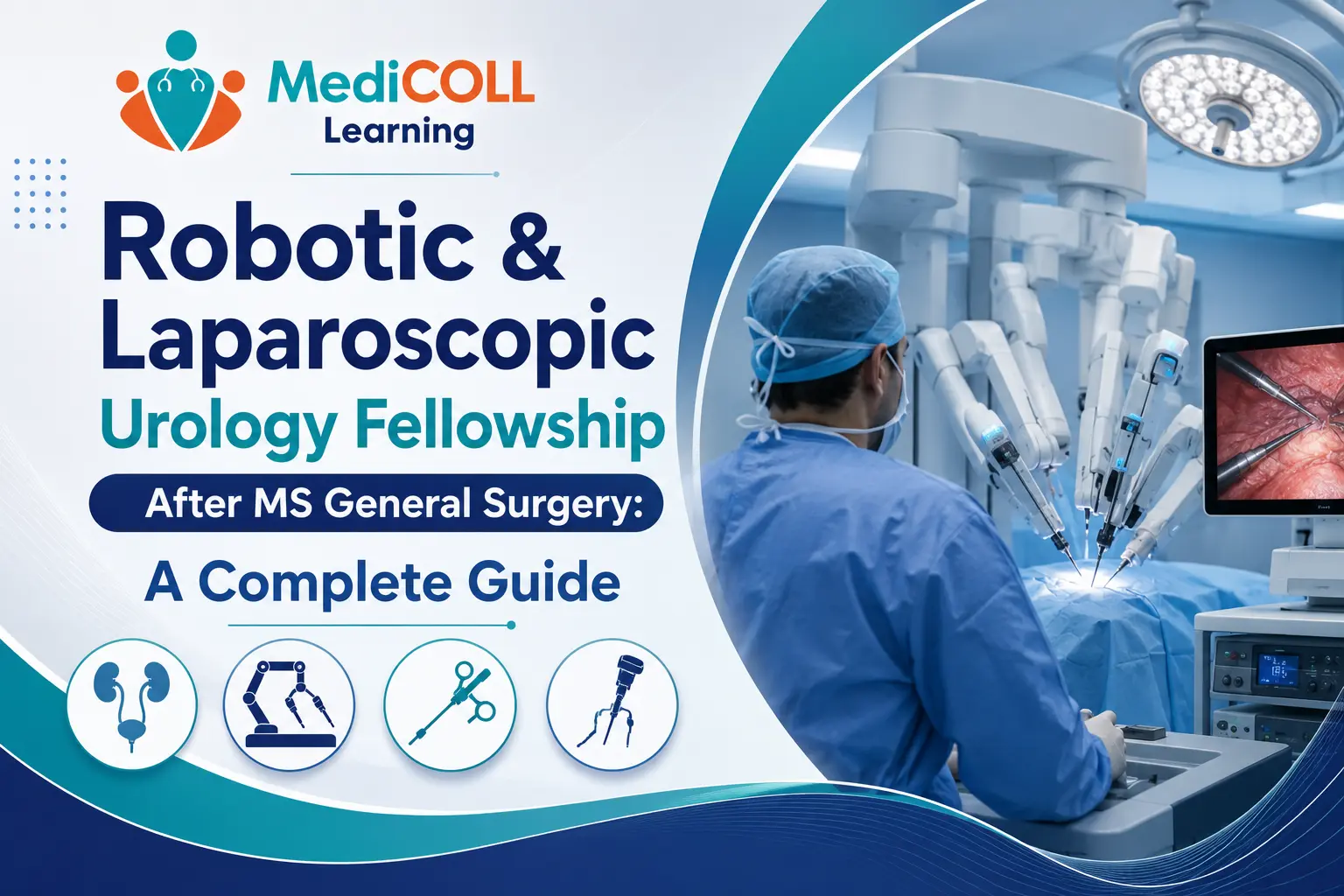
A robotic and laparoscopic urology fellowship is a medical training program in minimally invasive urological surgery. It covers robotic-assisted procedures and standard laparoscopy, using small ports instead of open incisions. It falls under the wider category of an intensive urology fellowship, built specifically for surgeons who already have a surgical base and want to move into a focused specialty fast.
This fellowship works as a bridge into urology for a surgeon coming from a general surgery background. Most programs cover nephrectomy, prostatectomy, pyeloplasty, and cystectomy.
The medical professionals pursuing fellowship are also trained on console handling, trocar placement, and intracorporeal suturing. Consequently, the learning stays practical from week one, not just observation from the back of the operation theatre (OT).
Surgeons who are weighing their options, this ends up being the best fellowship after MS General Surgery because it builds on pre-existing skills instead of starting fresh.
Trusted online fellowship programs are often accredited by recognised national or international medical educational authorities including NHS approved and MCI approved institutions such as:
Completing the program successfully earns participants a certificate of Fellowship in Urology, which adds professional credibility and reinforces their clinical expertise.

Urology gives general surgeons a way to specialise using skills they already have. It rewards precision, and it has adopted robotic platforms faster than most other surgical fields. A general fellowship in urology gives broad exposure, but a robotic urology fellowship narrows that further into a higher level skill hospitals are actively looking for right now.
MS General Surgery builds a strong base in anatomy and operative judgement. But general surgery today covers a wide range, and many surgeons want sharper focus after a few years of practice. For instance, robotic urology cases for prostate and kidney conditions are rising steadily across private hospitals in India. Hospitals want surgeons who are already trained on these systems and not ones learning from scratch. A fellowship in robotic surgery after MS General Surgery gets you there at that point of specialisation faster than a full super speciality program would.
Eligibility depends on the fellowship format. Shorter, hands-on training programs generally accept MS General Surgery candidates directly. Full one-year hospital-run fellowships tied to a super-specialty pathway often expect MCh or DNB in Urology first.
Short-term fellowships, usually a few months long, tend to stay open to MS General Surgery, MBBS with relevant experience, and sometimes DNB Urology candidates. Mid-length, six-month programs prefer MS or DNB General Surgery, though some centres do accept strong MBBS applicants. Full one-year hospital fellowships are usually restricted to MCh or DNB Urology, since these run closer to formal subspecialty training.
Always confirm directly with the institute before applying, since criteria shift between batches, and what counts as the best fellowship after MS General Surgery for one surgeon may not suit another depending on prior exposure.
The fellowship combines robotic console training, laparoscopic procedure exposure, and case-based learning across benign and cancer-related urology. Most programs also include perioperative care and case discussions.
Robotic console training covers docking, troubleshooting, and hands-on console time under supervision. Laparoscopic training focuses on procedures like nephrectomy, adrenalectomy, and reconstructive surgery.
Case discussions run across both benign and cancer-related urology conditions, and some programs add exposure to stone disease management through PCNL and RIRS. Perioperative care rounds out the training, covering everything from case planning to post-op management.
A few fellowships also build in research exposure, so medical professionals enrolled in the fellowship can work on case studies or present at conferences.
Console time matters more than anything else on this list. A program heavy on lectures and light on hands-on practice will not build real robotic skill in a urology robotic fellowship, no matter how good the curriculum looks on paper.
Fellowship duration ranges from one month to one year, depending on the format and the depth of training offered by various institutes, hospitals or organisations. Shorter programs suit working surgeons while longer ones suit those planning a full shift into urology.
Short-term hands-on training which runs one to three months, works well for surgeons who want focused exposure without stepping away from practice for too long. Six-month programs suit those planning a gradual transition. A full twelve-month fellowship suits surgeons ready to commit fully to urology practice.
A laparoscopic urology fellowship in India, particularly through private training institutes, often allows flexibility from the initial dates of enrollment. This suits doctors who cannot commit to a fixed academic calendar. Fees vary quite a bit by duration and hospital reputation, so it helps to compare more than one fellowship before deciding which learning program to pursue.
It comes down to high surgical volume combined with a limited pool of robotically trained surgeons. Conditions like kidney stones, prostate cancer, and reconstructive issues often need surgery, not just medication, which keeps caseloads steady through the year.
Robotic and laparoscopic skills add another layer to this. Patients increasingly prefer minimally invasive options, since recovery is faster and hospital stay is shorter. Surgeons trained on robotic platforms can offer this, and hospitals pay well for that skill set. There is also a supply gap.
Trained robotic urologists remain limited outside the biggest metro cities, which keeps compensation strong for surgeons who invest in this training early. This is also why a robotic urology fellowship tends to hold more market value today than a general surgical qualification al
Choose a fellowship based on actual console time, faculty experience with robotic cases specifically, and whether the certification holds recognised value where the medical professional plans to practice.
Check how much console time is guaranteed, not just observation hours.
Ask whether faculty have hands-on robotic case experience, since robotic and laparoscopic skills overlap but are not identical. Confirm whether the certifying body is recognised at the hospital or region where plan to work.
And where possible, talk to past participants since a brochure will not always capture how hands-on the training really was. This groundwork is what separates an average program from what most surgeons would call the best fellowship after MS General Surgery for their specific goals.
A robotic and laparoscopic urology fellowship after MS General Surgery is a practical and focused path for surgeons who want to specialise without starting over. The right program gives real console time, matches career timeline, and holds recognised value where the medical professional plans to practice. A specialised urology fellowship remains one of the more rewarding surgical paths today both in terms of clinically and financially.
If you're exploring this path, MediCOLL's Fellowship in Urology is built for exactly this kind of transition. As one of the organizations contributing to the healthcare field, MediCOLL offers various fellowship programs to medical professionals, and its Fellowship in Urology helps build a deeper understanding of urology for surgeons moving in this direction.
Yes, for short-term and mid-length hands-on programs. Full one-year hospital fellowships usually expect MCh or DNB Urology first.
They overlap but are not the same. Laparoscopic training covers manual minimally invasive technique, while robotic training adds console-based, robot-assisted procedures.
This depends on caseload during training and the hospital's own credentialing process, not the fellowship certificate alone.
Generally yes, largely due to robotic case demand and a limited pool of robotically trained surgeons, though this varies by city and practice setting.
© Copyrights Medicoll All rights reserved.