| Blog Summary |
|---|
| The advancing development of healthcare has introduced systems such as telemedicine so that healthcare services can be accessible by everyone. Now, patients have the option to seek medical advice from the comfort of their homes. However, there are a few points to keep in mind while selecting the mode. This blog breaks that down clearly, comparing telemedicine vs traditional healthcare across cost, outcomes, and everyday clinical use, so both patients and doctors can make that call with more confidence. |
Telemedicine has grown fast over the last few years, driven by better internet access, busier schedules, and a general shift toward convenience in how people manage their health. Meanwhile, traditional healthcare remains essential for many patients. Both systems exist side by side, and each works differently. The confusion for most patients, when weighing telemedicine vs traditional medicine, is not whether telemedicine works, it is knowing which situation calls for which approach. This distinction matters because it helps patients recognize the seriousness of their situation and seek the right kind of medical attention.
Telemedicine is the use of video calls, phone consultations, or messaging platforms to connect a patient with a doctor without a physical visit. It includes a quick prescription refill to a full mental health session conducted over a screen.
Doctors use it for follow-ups, minor illnesses, chronic disease monitoring, and second opinions and it brings healthcare services closer to people who cannot easily commute. For instance, a patient with a sore throat or a skin rash can often be assessed through telemedicine without stepping into a clinic or hospital.&
Traditional healthcare means visiting a doctor, clinic, or hospital in person for diagnosis and treatment. It relies on physical examination, direct observation, and on-the-spot tests such as blood work, X-rays, or ECGs (electrocardiogram).
This model has been the backbone of medicine for decades. Some clinical conditions simply cannot be assessed through a screen and need the physical presence of both doctor and patient. Doctors need to do a physical examination before deciding on treatment. Traditional healthcare benefits patients most when the diagnosis depends on physical findings than symptoms alone.

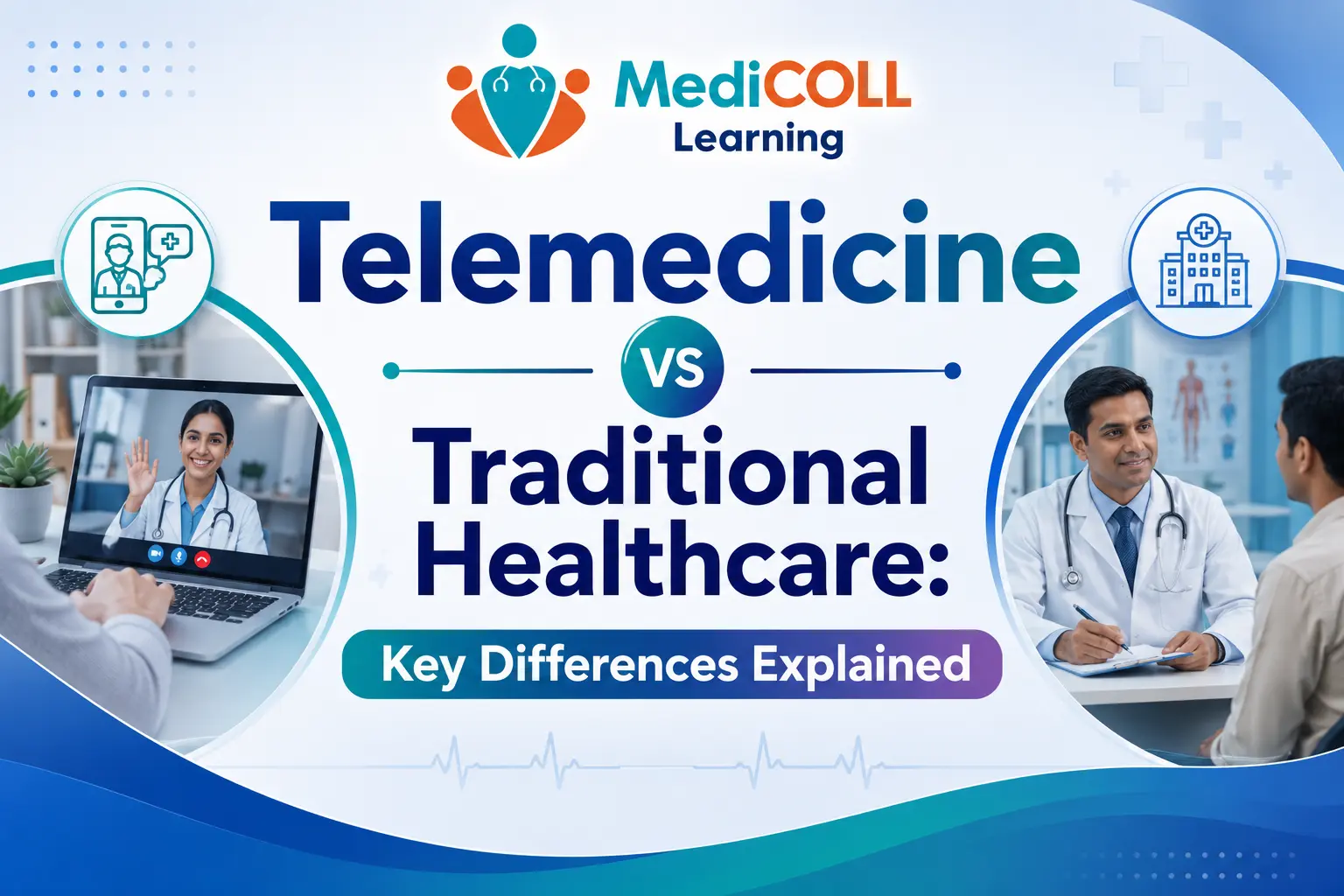
The differences between Telemedicine vs Traditional Healthcare are:
| Factor | Telemedicine | Traditional Healthcare |
|---|---|---|
| Consultation mode | Video, phone, or chat | In-person visit |
| Wait time | Usually shorter | Can involve longer waits |
| Physical examination | Not possible | Fully possible |
| Lab tests, imaging | Cannot be done remotely | Available on-site |
| Best suited for | Follow-ups, minor illness, mental health, chronic disease check-ins | Emergencies, surgeries, physical exams, complex diagnoses |
| Travel needed | None | Yes |
| Cost to patient | Often lower | Often higher, due to travel and clinic overheads |
| Record access | Digital, instant | May depend on the facility's system |
The above comparison shows that neither option is universally better. Virtual healthcare vs traditional healthcare is less about competition and more about matching the right mode to the right clinical situation.
Doctors and patients report several advantages of telemedicine once it becomes a part of routine care. Teleconsultation saves commuting time to hospital or clinic, especially for those patients who live far. It also reduces the transmission of any sort of infection such as in flu season or outbreaks and makes follow-up visits quicker and more consistent.
Telemedicine works well for mental health consultations, where a physical examination is rarely needed. Additionally, helps doctors monitor chronic conditions like diabetes or hypertension between visits and cuts down on missed appointments, since patients can join from home or work
Elderly patients and those with limited mobility often benefit the most. For example, a person managing hypertension may not need to visit a clinic every month if their readings can be shared and reviewed remotely.
Telemedicine is convenient, but it has clear boundaries that both doctors and patients need to respect. Some of the limitations of telemedicine include no physical examination, which limits diagnostic accuracy in many cases; cannot perform laboratory tests, imaging, or procedures and is less effective for conditions needing immediate, hands-on intervention. A doctor has to rely entirely on what the patient describes, which leaves room for missed detail.
Research comparing telemedicine visits with in-person primary care has found that video and phone consultations tend to result in fewer prescriptions and lower rates of laboratory or imaging orders compared to office visits. It also showed a modestly higher chance of needing a follow-up visit within a week. This does not mean telemedicine is unsafe. It simply reflects that certain conditions genuinely need a hands-on assessment
Traditional healthcare still holds an edge in situations that telemedicine cannot fully address. The traditional healthcare benefits are it allows a complete physical examination and enables immediate diagnostic testing, from blood work to scans. It also supports emergency and surgical care and builds a stronger doctor-patient relationship through repeated in-person contact.
Traditional healthcare is better suited for complex or multi-system conditions and reduces the risk of missing a symptom that only shows up on physical examination. Clinical conditions like abdominal pain or musculoskeletal injuries need a thorough scan for which an in-person visit remains the safer option.
A large primary care study comparing video, phone, and in-person visits found that in-person visits led to more prescriptions and laboratory or imaging orders. Video and phone visits saw slightly higher rates of a follow-up visit within seven days specifically for conditions like abdominal pain and musculoskeletal complaints.
Interestingly, mental health visits showed almost no difference between telemedicine and in-person care. This lines up with clinical logic. Conditions that depend on physical findings need physical assessment, while conditions built around conversation translate well to a screen. The takeaway for patients in telemedicine vs traditional medicine is not that one mode is unsafe. It is that outcome quality depends heavily on matching the visit type to the actual clinical concern.
Cost is often the deciding factor for patients, and the two models, telemedicine vs traditional healthcare, differ in where the savings actually show up.
In practice, telemedicine tends to save money on minor and routine care, while traditional healthcare's added cost is usually justified when diagnostics or a physical examination are unavoidable.
Doctors trained through structured programs, such as the fellowship and certificate courses offered by MediCOLL Learning, are often better equipped to judge when a teleconsultation is enough and when a patient actually needs to be seen in person. This kind of clinical judgment matters more as both models continue to run side by side.
The future of telemedicine in India looks promising as internet and smartphone usage keeps growing, helping more patients receive timely care while easing rush at hospitals. Telemedicine and traditional healthcare are not competing against each other, they are simply built for different jobs. A follow-up or a medication review fits telemedicine well, while anything needing a physical examination, a laboratory test, or urgent attention still belongs in a clinic or hospital. Most patients end up using a mix of both, depending on what a particular visit calls for.
For doctors, understanding where each model fits is becoming as important as clinical knowledge itself. Programs like the fellowship and certificate courses at MediCOLL Learning help practising doctors build this kind of judgment, alongside updated clinical training, without stepping away from active practice.
Telemedicine works well for minor illnesses, follow-ups, and mental health consultations. For medical conditions needing a physical examination or any tests for the confirmation of the diagnosis, in-person traditional care is more reliable.
The limitation of telemedicine is that it cannot substitute for physical examinations, laboratory tests, or imaging conducted by medical professionals.
Data showed a slight higher chance of a return visit within a week after telemedicine, particularly in cases of abdominal or musculoskeletal pain. However, Mental health consultation indicates almost no difference in follow-up visits.
Telemedicine is usually less expensive for minor and routine care, since it removes travel and clinic overhead costs.
Choosing between the two depends on the symptoms exhibited. Minor or routine concerns suit virtual healthcare but if there is anything that needs a physical examination or urgent care, one should go through traditional healthcare.
© Copyrights Medicoll All rights reserved.