| Blog Summary |
|---|
| There are many diverse types of nursing specialties today, shaped by changes in the healthcare field such as newer protocols, treatments, and technology. This blog takes through 10 nursing fields that are growing fast in 2026, the career options each one of the nursing specialty opens up, and how to figure out which path fits the best. |
Nurses doing the job might look the same from the outside, but in reality, each role has its own specific demands. It becomes clearer how specialised this profession has turned into, once you start looking at the different types of nurses working in hospitals today.
There are many types of specialties now, such as intensive care, mental health, and nursing education, and each one needs its own training and mindset. Choosing among all the available specialties to find the best nursing specialty requires an understanding of long-term career goals and time investment.
Nursing specialties allow registered nurses to focus on specific patient populations, medical conditions, or healthcare settings. Advanced specialties, such as Nurse Anesthetists or Nurse Practitioners, typically require graduate degrees, while general certifications, fellowships and diplomas build expertise in targeted patient care. This is also where the different types of nurses start to look quite distinct from each other though they have the same basic degree.
Healthcare has changed a lot in the last few years with newer clinical guidelines, technological advancement, increase in the burden of diseases and growing aging population. All of which has also caused changes in the nursing field as well.
Hospitals are seeing an increasing influx of chronic diseases and geriatric patients. At the same time, technology like electronic health records (EHR) and remote monitoring has created jobs that didn't exist a decade ago.
Because of this, nursing career options have grown well past the general ward nurse most people picture. Specifically, fields tied to ageing care, mental health, and health data are seeing the fastest hiring right now, both in India and abroad.

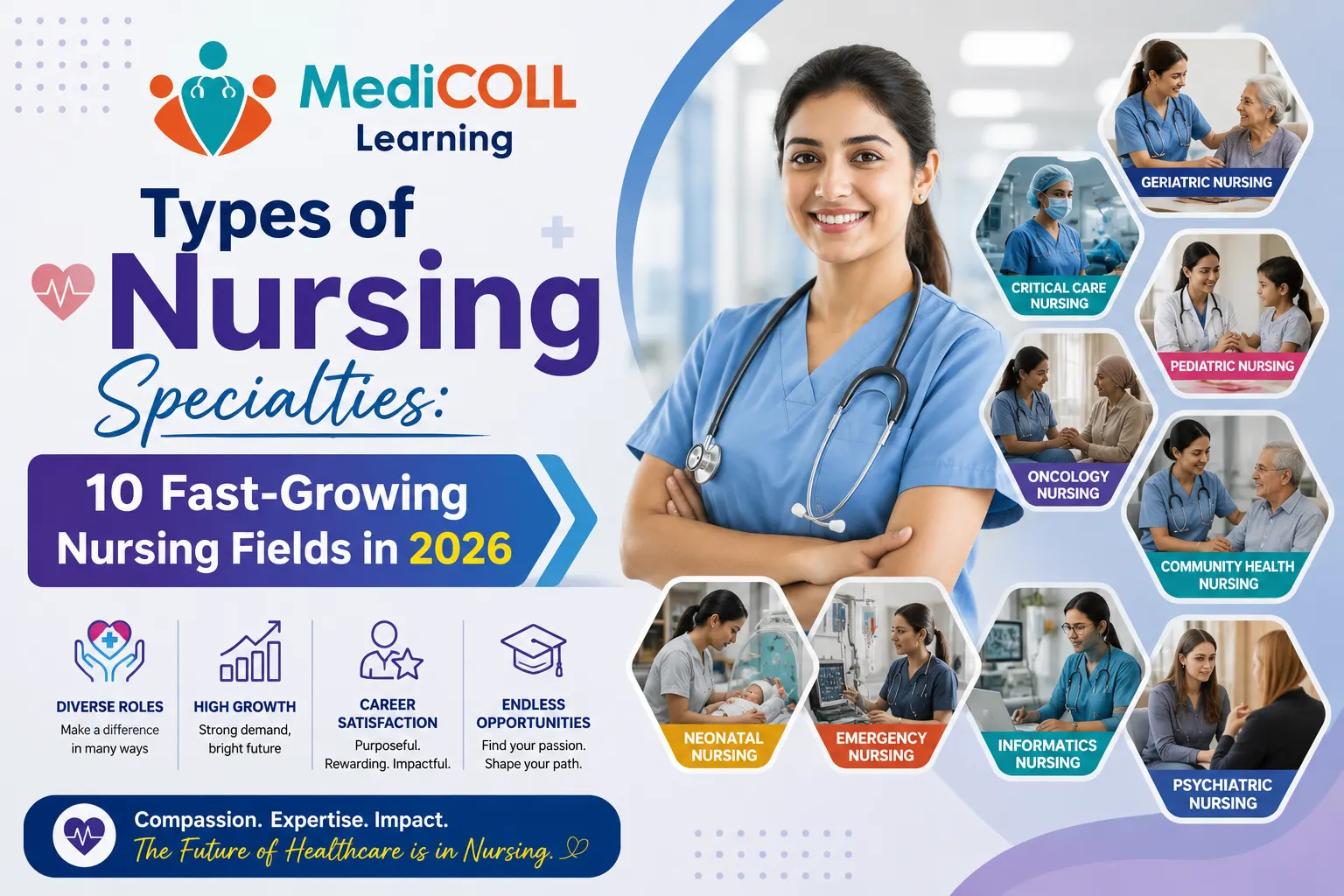
Here are ten types of nursing Specialties seeing strong demand this year, along with what each one actually involves on the job.
Critical care nurses look after severely ill patients whose condition can worsen within minutes. They work in intensive care units and often make quick calls before a doctor reaches the bedside. Hospitals keep adding ICU beds every year, which keeps demand for trained critical care nurses high.
Oncology nurses care for cancer patients through diagnosis, chemotherapy, radiation, and recovery. A big part of the job is explaining treatment side effects and helping families cope with a hard diagnosis. As cancer cases keep rising across age groups, oncology units are hiring consistently.
A nurse practitioner takes on work that overlaps with a doctor's, such as diagnosing common illnesses, ordering tests, and prescribing medicines, depending on local rules. This role needs a master's degree on top of an RN licence.
Mental health nurses work with patients dealing with depression, anxiety, addiction, and other psychiatric conditions. The job leans on conversation, observation, and patience rather than machines or charts. As the awareness around mental health has grown in recent years, the need for nurses trained to handle it properly is also expanding.
Geriatric nurses specialise in the health needs of older adults such as managing multiple medications and spot early signs of memory loss. As life expectancy rises, more families are turning to trained geriatric nurses for both hospital and home-based care. This is one of the steadiest, least talked-about nursing fields in healthcare today.
Pediatric nurses are specialised medical professionals who provide direct care to infants, children, and adolescents. They manage developmental screenings, administer treatments, and advocate for young patients in clinical settings like hospitals or specialty clinics.
Perioperative nurses work before, during, and after surgery. They prepare the operating room, assist the surgical team, and monitor the patient as they come out of anaesthesia. Surgical volumes are rising partly because more procedures now need shorter hospital stays which keeps demand high for specialised nurses in this role.
A nurse anesthetist (often called a CRNA in the US) administers anaesthesia and monitors patients through surgery, working closely with surgeons. This is one of the more advanced nursing fields, requiring extra certification beyond a basic RN licence, and it tends to come with one of the better pay scales in nursing.
Nursing informatics is where clinical nursing meets technology. These nurses help hospitals manage electronic health records, patient data systems, and digital workflows, often training other staff to use new software properly. As more hospitals move records online, informatics nurses are becoming the contact point between IT teams and the people actually using the systems. This serves as one of the recently developing nursing career options.
A nurse educator is a registered nurse who blends clinical expertise with teaching skills to educate future nurses or provide continuous development for licensed staff. They work in hospitals as clinical educators or in universities as academic faculty. This ensures high educational standards and better patient care.
| Specialty | Best Suited For | Common Work Setting |
|---|---|---|
| Critical Care Nurse | Calm, quick decision-makers | ICU |
| Oncology Nurse | Patient, steady communicators | Cancer centres, hospitals |
| Nurse Practitioner | Those wanting more clinical independence | Clinics, hospitals |
| Mental Health Nurse | Good listeners | Psychiatric units, rehab centres |
| Geriatric Nurse | Patient, long-term caregivers | Hospitals, home care |
| Pediatric Nurse | Gentle, kid-friendly nurses | Children's wards |
| Perioperative Nurse | Detail-oriented, steady-handed nurses | Operating rooms |
| Nurse Anesthetist | High-responsibility, advanced learners | Surgical units |
| Nursing Informatics Specialist | Tech-comfortable nurses | Hospital IT/EHR teams |
| Nurse Educator | Natural teachers | Nursing colleges, training departments |
A simple way to narrow down among so many types of nursing careers is to think about three things: the kind of patients like working with, how much hands-on technical skill versus conversation the job needs, and how much further study one is willing to put in. The right field of specialisation is probably the role which keeps interest on a hard day, not just a good one.
There are various types of nursing specialties available today such as ICU, oncology, informatics and education. But access to many specialties can also create confusion about which field actually suits the best. Fellowship programs or certificates can help with this and give nurses a chance to spend time near a few fields of interest through structured clinical training programs.
This makes it easier to identify the right field before committing to it long term. MediColl is one of the organisations that provide globally accredited fellowships in nursing care and help nurses upskill.
The highest qualification in nursing is a doctoral degree, either a PhD in Nursing, which is research-focused, or a Doctor of Nursing Practice (DNP), which is built around advanced clinical practice. Most nurses reach this level after a BSc or GNM, followed by an MSc in Nursing, before applying to a doctoral program.
According to the UK nursing system, nursing fields in healthcare are officially split into four fields which are adult nursing, children's nursing, mental health nursing, and learning disability nursing. These fields let nurses specialise in treating specific patient groups or conditions, and similar divisions show up in nursing systems elsewhere, even if the exact names differ.
© Copyrights Medicoll All rights reserved.