| Blog Summary |
|---|
| The Emergency Department is often the first point of care for patients with acute and life-threatening conditions. A Certificate in Emergency Medicine helps doctors strengthen their knowledge of emergency assessment, clinical decision-making, and patient management. This blog covers eligibility, skills, curriculum, career scope, and job opportunities while explaining how emergency medicine training can support professional growth. |
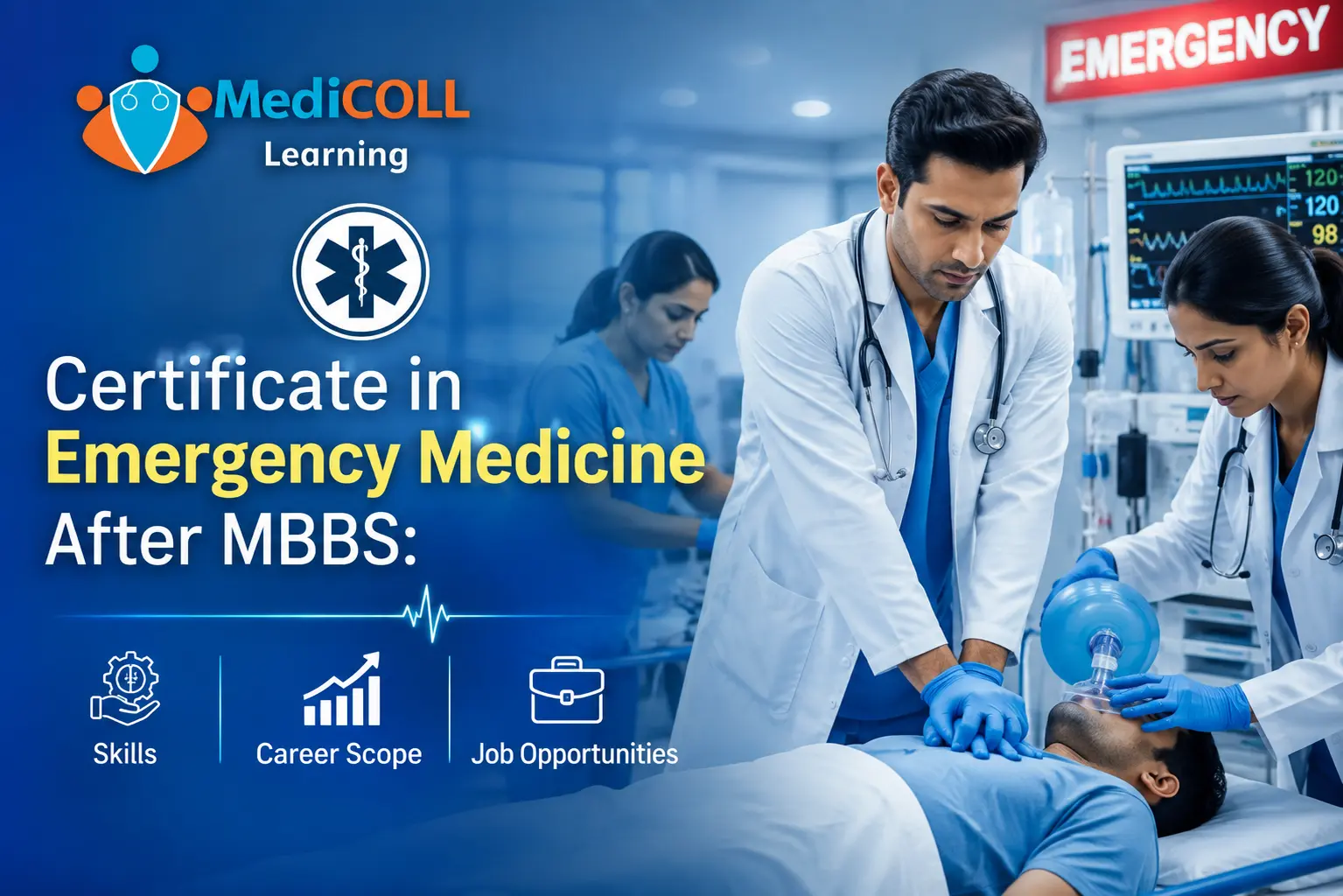
Quick decision-making, calm hands under pressure, and the ability to stabilise a patient before the full picture is even clear, this is what sets an emergency doctor apart. A Certificate in Emergency Medicine after MBBS is built around helping doctors gain a deeper understanding of this field of medicine. It adds a focused layer of training that helps doctors upskill and gain the confidence to perform procedures on patients with ease.
A Certificate in Emergency Medicine is a short, focused training program designed to sharpen a doctor's ability to manage urgent and critical cases. It usually covers trauma response, airway management, resuscitation protocols, and the kind of rapid clinical judgment that emergency settings demand every single day.
This certificate course is built for doctors who want targeted knowledge and generally follows an online approach to build professional competencies. The blended format provides doctors with the flexibility to learn at their own convenience without stepping away from their clinical practice.
Several institutes offer Emergency Medicine Certificate Course in India. MediCOLL Learning is one option worth noting, since its courses are accredited by bodies such as the NHS, eIntegrity, and the University of Liverpool, CPD standard office alongside affiliation with Mangalayatan University for recognition within the Indian university system. This combination of international and domestic accreditation is something doctors often look for when choosing where to enroll.
Upon successful completion of the course and required assessments, participants will receive a course completion certificate that reflects their learning achievements and commitment to professional development in their chosen medical specialty.

Emergency medicine is one of the most rewarding yet most demanding areas of medicine. Doctors in this department need to be on their toes and skilled enough to perform procedures on patients with confidence. An Emergency Medicine course after MBBS helps doctors stay updated with current clinical guidelines.
Career flexibility is another benefit, since emergency-trained doctors are needed almost everywhere, from small nursing homes to large trauma centres. Some doctors also see it as a stepping stone toward critical care or anaesthesia later on, since the foundational skills overlap.
And for those working in tier two or tier three cities, where emergency departments often run with fewer specialists on hand, this kind of Emergency Medicine certification for doctors can make a doctor more valuable to the hospital they work in, and more confident in their own clinical judgment.
The eligibility criteria vary from institutes. The Certificate in Emergency Medicine after MBBS mostly is open to all medical professionals. Eligible candidates include:

The certificate spans three to six months, depending on the institute and the curriculum. Fellowships, by comparison, generally run longer, often around one year. The learning format varies across institutes, but most courses are online, which gives doctors the advantage of not having to relocate to another city, something that usually comes with offline programs.
This Online Certificate in Emergency Medicine is structured so working doctors do not have to pause their clinical duties to complete it. That balance between study and practice is often what makes the difference between doctors finishing a course and doctors dropping out halfway.
The Emergency Medicine skills for doctors includes:
The curriculum of Certificate in Emergency Medicine in India follows a layered approach, starting with how a doctor functions inside the emergency department itself before moving into specific clinical emergencies. This general grounding covers triage, documentation, patient handovers, and the everyday judgement calls that come with working in a fast-moving department.
The curriculum also includes:
Emergency medicine as a field is growing steadily in India because hospitals are expanding their emergency infrastructure as well as an increase in road traffic accidents, heart medical conditions, and other acute cases. This creates a wide Emergency Medicine career scope for doctors who complete focused training.
Certified doctors may also find strong demand in semi-urban areas, where emergency departments often struggle to find doctors with this specific skill set. Some doctors use the certification as a base and later move toward postgraduate study in emergency medicine or critical care. While others build a long, stable career directly in emergency practice itself, moving between hospitals, trauma centres, and even flight or ambulance-based critical care teams as their experience grows.
After the completion of the certificate, doctors can find openings as casualty medical officers, emergency duty doctors, or ICU support physicians. Urgent care centres also look for doctors with this training.
Some doctors who are interested can go on to work with ambulance services or air ambulance teams, roles that specifically require fast, decisive emergency judgement. Corporate hospitals and government hospitals both value this Emergency Medicine course for MBBS doctors when hiring. A certified doctor can stand apart from general MBBS graduates simply because the training reflects the doctor’s interest to continue their professional development.
The cost of an emergency medicine course typically ranges between ₹50,000 and ₹1,50,000, depending on the institute and program duration. MediCOLL offers its Certificate in Emergency Medicine at ₹70,000, inclusive of all taxes. Doctors who prefer not to pay the full fee upfront can opt for a three-month installment plan at no extra cost. This flexibility can make a real difference for doctors who want to continue their learning journey without the pressure of a large one-time payment.
The certificate adds a meaningful aspect to a doctor's professional profile. It prepares doctors to manage patients more effectively, even outside a dedicated emergency setting. In instances where an emergency arises in a regular clinic, a doctor holding a certificate in emergency medicine can act promptly, before the patient's condition deteriorates further.
Programs like the one offered through MediCOLL Learning are built with this wider use in mind, combining structured content with case discussions led by experts, so doctors carry these skills into whatever setting they eventually work in.
A Certificate in Emergency Medicine after MBBS gives doctors a structured, practical way to build the confidence and skill set this specialty demands. The certificate not only helps doctors develop clinical skills but also provides a gateway to better career opportunities. The online structure of the program enables doctors to continue their learning journey without time constraints.
Yes, the certificate is accredited by esteemed bodies like NHS, eIntergrity, University of Liverpool and Mangalayatan University along with CPD standard offices.
The format of the program depends on the institute. Many programs are designed with working professionals in mind, though the exact schedule and structure should be
confirmed with the specific course provider.
The Emergency Medicine certification in India is open to all medical professionals. This includes MBBS graduates, Post graduates like MD, Final year MBBS Students, DNB/FNB Holders and AYUSH Practitioners.
Fresh MBBS graduates benefit early on, but general physicians, family doctors, and even specialists looking to sharpen their emergency response skills often find it useful too.
Prior ER experience is not typically mandatory to enroll in the certificate though can be useful as it acts as a foundation to develop further skills.
© Copyrights Medicoll All rights reserved.