| Blog Summary |
|---|
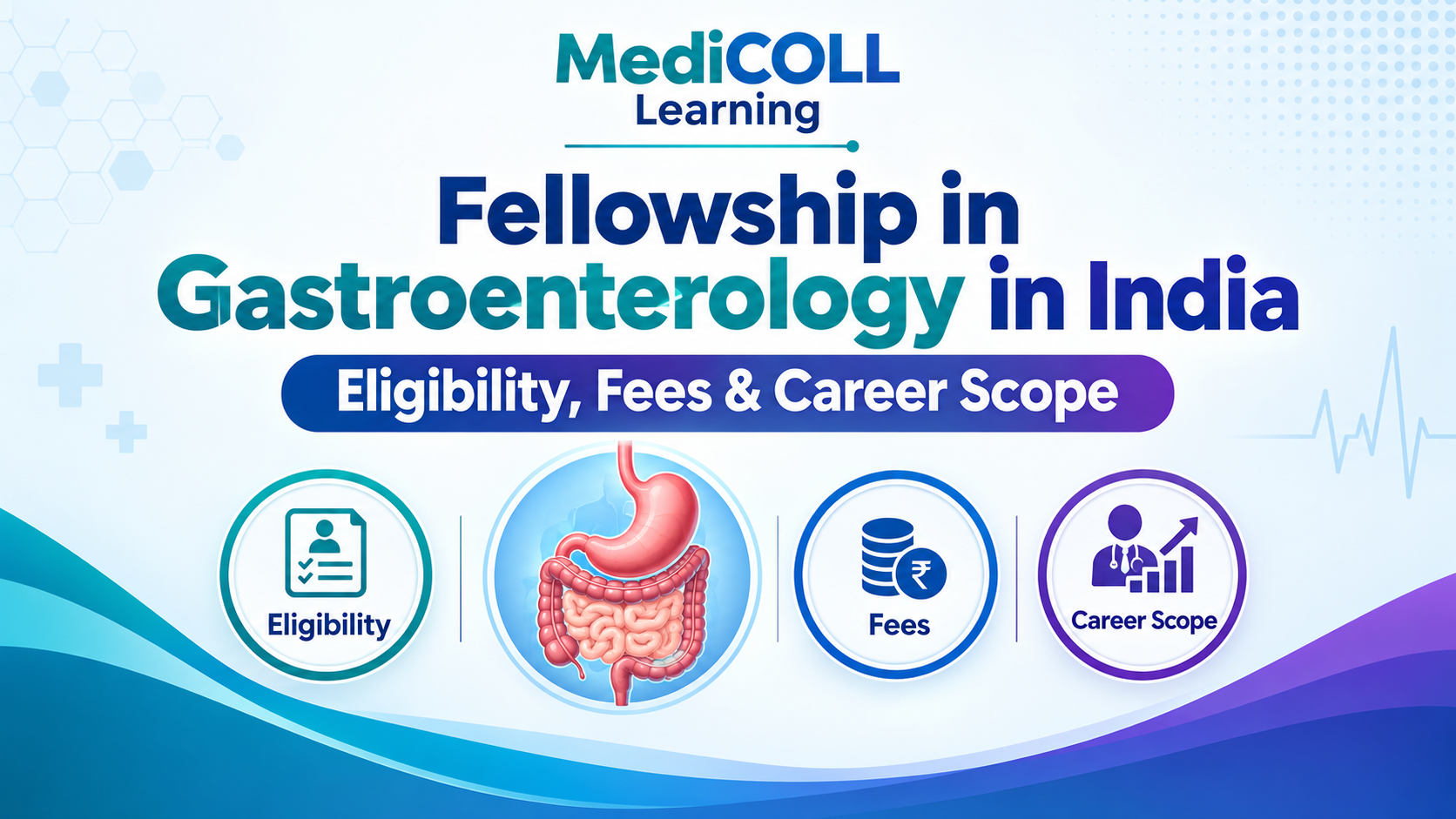
| Gastrointestinal, liver and biliary disorders are common in everyday practice, from gastroenteritis, dyspepsia and acid reflux to chronic liver disease. Most OPDs see them daily, so doctors need a sound working knowledge of these conditions to manage patients early and improve their outcomes. This blog looks at the fellowship in gastroenterology in India: who can apply, how long it runs and what it costs. It also compares the fellowship with DM/DrNB and explains where the two differ. |
Reflux, dyspepsia, deranged LFTs and a fatty liver on ultrasound are common findings for doctors in clinical practice. A 2022 review of gastrointestinal and liver disease burden in India reported that some form of liver disease affects 20% to 25% of the population. Another 2025 review states the global prevalence of GERD at about 13.98% . The first doctor these patients meet is often a physician or a general practitioner, and any referral to a gastroenterologist comes later. A fellowship in gastroenterology gives doctors a way to build their knowledge while they continue to practise, without committing to a postgraduate degree.
Gastroenterology covers the oesophagus, stomach, bowel, liver, pancreas and biliary tree. A fellowship of this kind is a structured course that helps doctors manage gastrointestinal, liver and biliary problems with more confidence. It suits:
MediCOLL Learning’s fellowship in gastroenterology has been designed by experienced gastroenterologists, and its content follows the conditions doctors meet most often, with current approaches to diagnosis and treatment, so that what is learnt can be applied in the doctor’s own practice.
The entry requirements for a fellowship differ from one institute to another. MediCOLL Learning’s eligibility criteria include:
A fellowship in gastroenterology after MBBS is an option for fresh MBBS graduates, and for experienced practising doctors who want to build their clinical knowledge and skills to support patient care better. Many practising doctors already see GI cases in a nursing home, a district hospital or a general practice, and have picked up most of it on the job. A course gives that learning some structure.
A fellowship is an additional certification on top of a graduate or postgraduate degree. It shows a commitment to keep pace with updated guidelines and to keep learning.
A fellowship in gastroenterology after MD medicine is also a suitable option for doctors who want to learn more about various gastrointestinal conditions. An MD or DNB physician already manages conditions like decompensated cirrhosis, upper GI bleeds and acute pancreatitis and the fellowship can help tighten those treatment decisions.
A fellowship in gastroenterology after BHMS can help BHMS graduates build their clinical knowledge and sharpen their diagnostic and screening skills, so they can support patients with gastrointestinal, liver and biliary disorders better. Institutes do accept AYUSH professionals into their programme but it is always advisable to ask the provider about the eligibility criteria.
Across India, the total duration of an online fellowship in gastroenterology varies from one to three years, and the format can be fully on-site, fully online or hybrid. MediCOLL Learning’s programme is hybrid, with ten months of online classes led by an expert, then two months of supervised clinical training in a super-specialty hospital.
The online sessions cover the theoretical subjects by an experienced faculty and help enrolled doctors understand the concepts before applying them in the clinical posting while the clinical training in a hospital helps doctors get exposure to real-world settings and understand patient scenarios.
The Fellowship in Gastroenterology is affiliated with the NHS, eIntegrity, University of Liverpool and Mangalayatan University, and carries CPD accreditation from The CPD Standards Office. CPD points, also called hours or credits, record the time and active engagement spent on professional learning and skill enhancement. CPD accreditation can also add weight to the profile of Indian doctors who plan to apply for study or work abroad.
Fees vary widely in India. The cost goes up when a course includes live faculty, assessments or a hospital posting. MediCOLL Learning’s one year fellowship in gastroenterology costs ₹ 1,55,000 for the 12 months. Doctors who prefer not to pay upfront can also opt for EMI at no extra cost through financing.
MediCOLL Learning’s syllabus has multiple modules across diagnosis and treatment. The clinical core covers GERD, H. pylori, IBD scoring and biologics, IBS by Rome IV and a full hepatology module with Child-Pugh, MELD, portal hypertension and variceal bleeding. Diagnostic modalities, nutrition, GI emergencies, pancreatic and biliary disease and GI oncology each have a module. Endoscopy runs from core skills and sedation to ERCP, EUS, capsule endoscopy and EMR/ESD, plus a module on non-technical skills such as crisis management.
The advanced endoscopy modules in this fellowship in gastroenterology teach the indications, technique and complications of procedures like ERCP and EUS.
The career scope spans private clinical practice, corporate hospital networks, academic institutions and specialised research, depending on your base qualification and the employer’s requirements. The fellowship can also help doctors develop more confidence with GI and liver cases and a better sense of when to refer.
If interested, doctors who complete a 1 year fellowship in gastroenterology can also follow a career in the corporate health sector, such as medical affairs and pharma, medical device companies and clinical research.
If a doctor wants to achieve a formal degree, DM or DrNB is the route. However, if a doctor wants to handle GI and liver cases better and add a certification to their name while continuing to practice , or wants some clinical experience before committing to a long-term pathway, a fellowship makes more sense.
The difference between Fellowship in Gastroenterology vs DM/DrNB are:
| Point | Fellowship | DM / DrNB |
|---|---|---|
| Eligibility | Depends on the institute. Usually, MBBS, MD/DNB/FNB holders, AYUSH practitioners and international medical graduates (IMGs) may be eligible. | MD/DNB in General Medicine or an accepted branch. |
| Admission | Through the provider. Entrance exam requirements vary by institute. | NEET-SS and counselling. |
| Duration | 1 to 3 years. | 3 years. |
| Training | Varies by institute: hybrid, fully online or on-site. | Full-time residency in a recognised department. |
When comparing a fellowship in gastroenterology across different institutes, a few points help to judge whether it will be useful for the doctor’s future practice:
A fellowship is a significant commitment of time and fees, so these questions are better asked before enrolment than after.
Yes, the 1 year fellowship in gastroenterology by MediCOLL Learning is valid and recognised. It is accredited with the NHS, eIntegrity, University of Liverpool and Mangalayatan University, and carries CPD accreditation.
The duration of a fellowship ranges from one to two years, depending on the provider. Fellowship by MediCOLL Learning runs for 12 months which includes 10 months of online classes followed by two months in a super-specialty hospital under supervision.
The fellowship in gastroenterology is a skill enhancement programme that helps doctors develop a deeper understanding of their chosen field of specialty. Moreover, hybrid programmes add clinical exposure to the theory.
Yes, the basic educational requirement of any fellowship is an MBBS graduate degree with valid medical registration.
The fee varies from institute to institute. MediCOLL Learning provides fellowship in gastroenterology at ₹ 1,55,000. If a doctor is unwilling to pay upfront, the doctor has the option to pay in monthly installments through financing at no extra cost.
© Copyrights Medicoll All rights reserved.